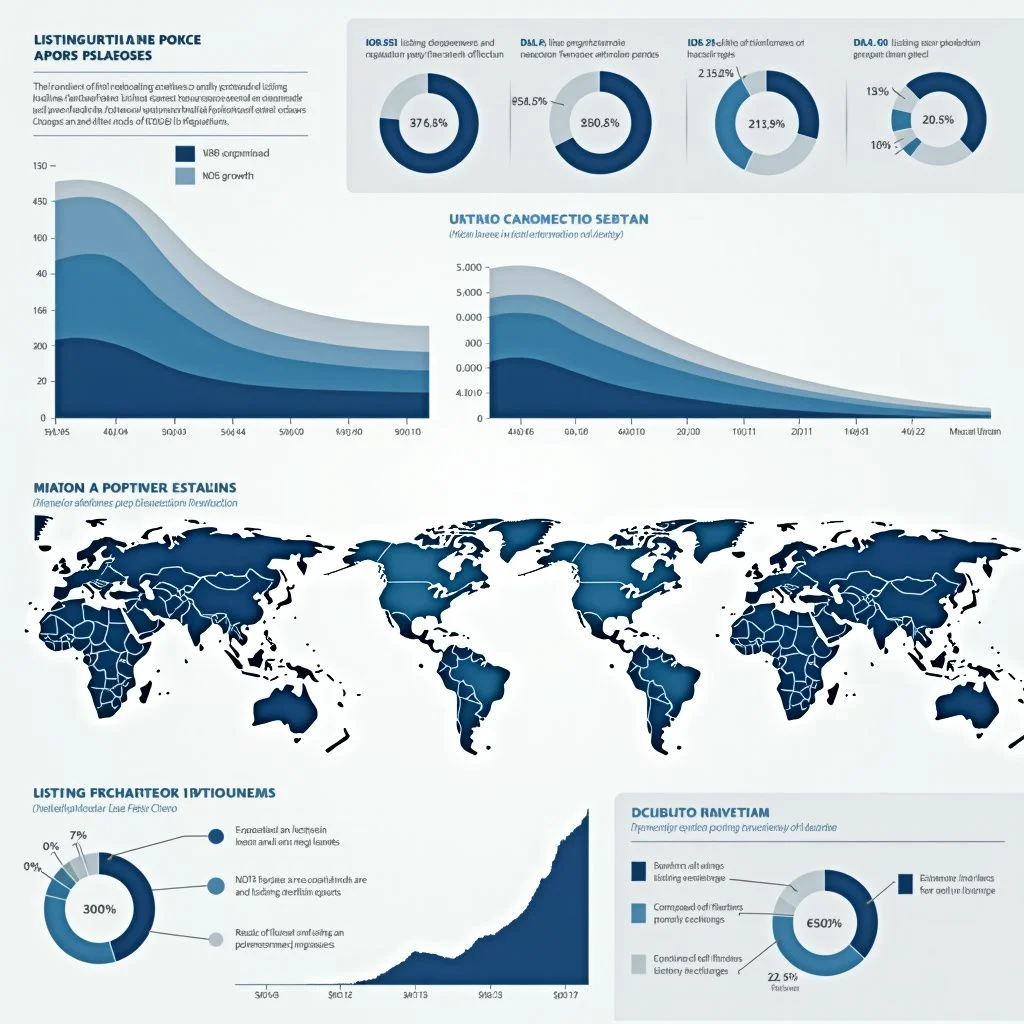
This paper investigates the factors influencing Initial Public Offering (IPO) activity across 79 global stock exchanges from 2002 to 2024, encompassing both advanced and emerging and developing economies. The analysis employs panel regressions with high-dimensional fixed effects and a comprehensive set of market and macro-financial variables. The findings reveal that market liquidity and GDP growth are consistently correlated with IPO frequency. Financial development, particularly in emerging markets, is associated with larger offering sizes. In contrast, the impact of market returns and volatility diminishes when regional-time fixed effects are controlled for, indicating that their influence is tied to regional market cycles, structural shifts, or varying policy environments over time.
Structural Asymmetries between Emerging and Advanced Economies
The study underscores structural asymmetries between emerging and advanced economies. Emerging markets demonstrate greater responsiveness to improvements in liquidity, financial development, and economic growth. Advanced economies, on the other hand, show stronger sensitivity to volatility and economic conditions, particularly in terms of IPO frequency.
Listing Stringency Index (LSI)
A novel Listing Stringency Index (LSI) is introduced to measure the stringency of listing requirements. Cross-exchange comparisons reveal that stricter listing requirements are associated with larger IPO sizes, likely due to a selection effect where only larger firms meet higher thresholds. However, this does not necessarily translate to increased IPO frequency. The evidence also suggests that relaxing listing requirements within exchanges over time leads to a significant increase in both IPO participation and capital raised. This highlights the potential for regulatory reform to broaden market access.
Dynamics of IPO Activity in Different Economic Contexts
The analysis further explores the dynamics of IPO activity in different economic contexts. In emerging markets, the positive correlation between financial development and offering sizes indicates that as financial systems mature, larger firms are more likely to go public. This trend is less pronounced in advanced economies, where financial development is already high and other factors, such as regulatory environment and market stability, play a more significant role.
Market Liquidity and IPO Activity
The study also examines the role of market liquidity in IPO activity. High liquidity markets tend to attract more IPOs, as they provide easier access to capital and lower transaction costs. This effect is more pronounced in emerging markets, where liquidity improvements can lead to a surge in IPO activity. In advanced economies, while liquidity remains important, other factors such as market volatility and economic conditions have a more significant impact on IPO frequency.
Impact of Market Returns and Volatility on IPO Activity
The impact of market returns and volatility on IPO activity is nuanced. While high market returns can encourage more firms to go public, the relationship is complex and varies across regions and time periods. Volatility, on the other hand, can deter IPO activity, as it increases uncertainty and risk for potential investors. The analysis shows that the effect of volatility is more pronounced in advanced economies, where market participants are more sensitive to fluctuations.
Regulatory Reforms and IPO Activity
The analysis also considers the impact of regulatory reforms on IPO activity. Relaxing listing requirements within exchanges over time can lead to a significant increase in both IPO participation and capital raised. This highlights the potential for regulatory reform to broaden market access and encourage more firms to go public. The findings suggest that policymakers and exchanges should carefully consider the balance between stringent listing requirements and market access when designing regulatory frameworks.
Conclusion and Implications
The study contributes to the literature on market structure and IPO dynamics by providing a comprehensive analysis of the factors influencing IPO activity across different economic contexts. The findings offer valuable insights for policymakers, exchanges, and market participants aiming to strengthen public capital markets globally. By understanding the complex interplay between market liquidity, financial development, economic growth, and regulatory environments, stakeholders can develop more effective strategies to promote IPO activity and enhance market efficiency.
Regional and Temporal Variations in IPO Activity
The analysis also highlights the importance of regional and temporal variations in IPO activity. The impact of market returns, volatility, and other factors can vary significantly across different regions and time periods. This underscores the need for a nuanced understanding of the factors influencing IPO activity and the importance of tailored regulatory and policy responses.
Policy Implications
The study’s findings have implications for both emerging and advanced economies. In emerging markets, policymakers should focus on improving market liquidity, financial development, and economic growth to encourage more IPOs. In advanced economies, attention should be given to managing market volatility and ensuring stable economic conditions to support IPO activity. Additionally, regulatory reforms that balance stringent listing requirements with market access can help broaden participation and raise more capital.
El papel del entorno regulatorio en la configuración de la actividad de IPO también se destaca. Los requisitos de lista estrictos pueden llevar a tamaños de IPO más grandes, pero también pueden actuar como una barrera de entrada para las empresas más pequeñas. Aliviar estos requisitos puede aumentar la participación en IPO y la capital recaudada, pero es importante asegurarse de que el entorno regulatorio permanezca robusto y transparente. Los formuladores de políticas y las bolsas de valores deben esforzarse por crear un marco regulatorio que apoye el acceso al mercado mientras mantiene altos estándares de gobernanza corporativa y informes financieros.
Importancia de un entorno regulatorio adecuado
El estudio analiza exhaustivamente la actividad de IPO en diferentes contextos económicos, proporcionando valiosas lecciones para los partes interesadas que buscan fortalecer los mercados de capital público. Al entender los factores que influyen en la actividad de IPO y la importancia de los entornos regulatorios, los formuladores de políticas, las bolsas de valores y los participantes del mercado pueden desarrollar estrategias más efectivas para promover la eficiencia y el crecimiento del mercado. Los hallazgos subrayan la necesidad de un enfoque matizado que considere las características únicas de diferentes mercados y la naturaleza dinámica de la actividad de IPO.