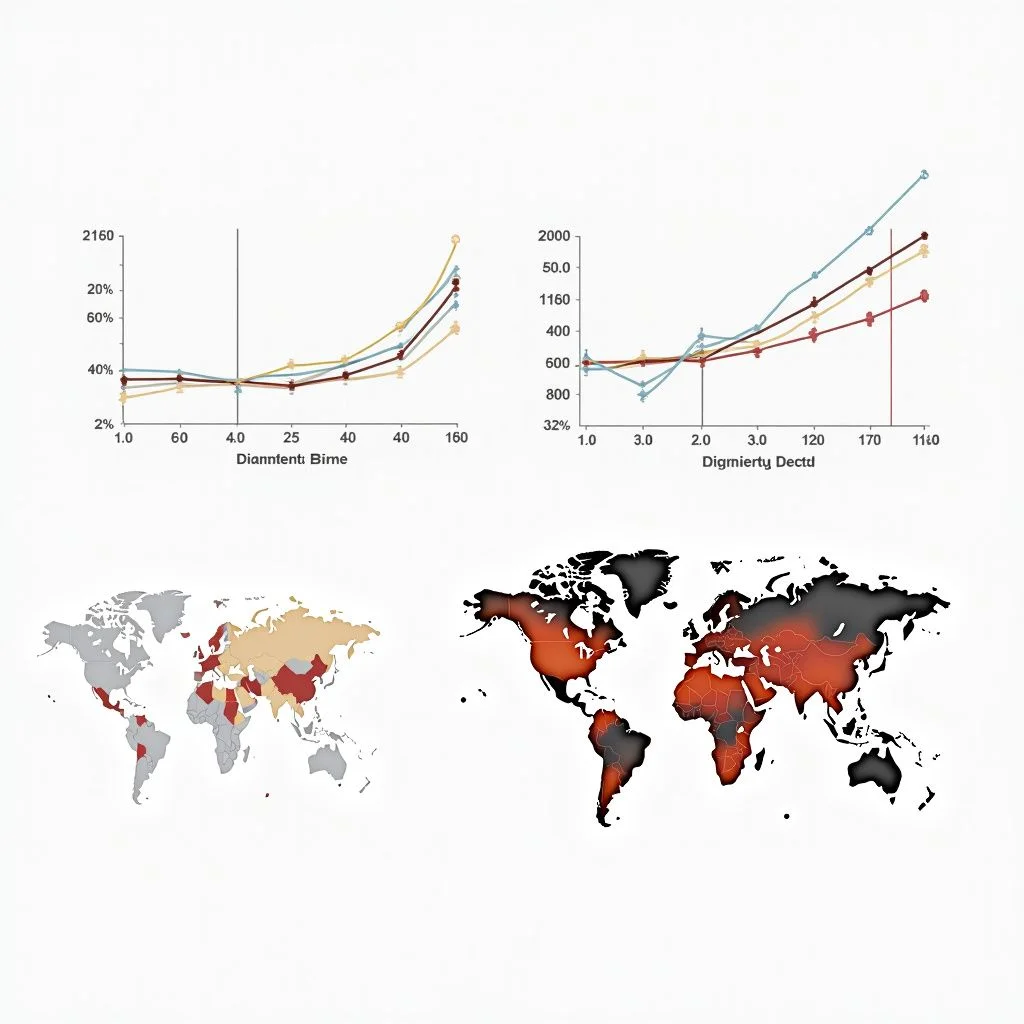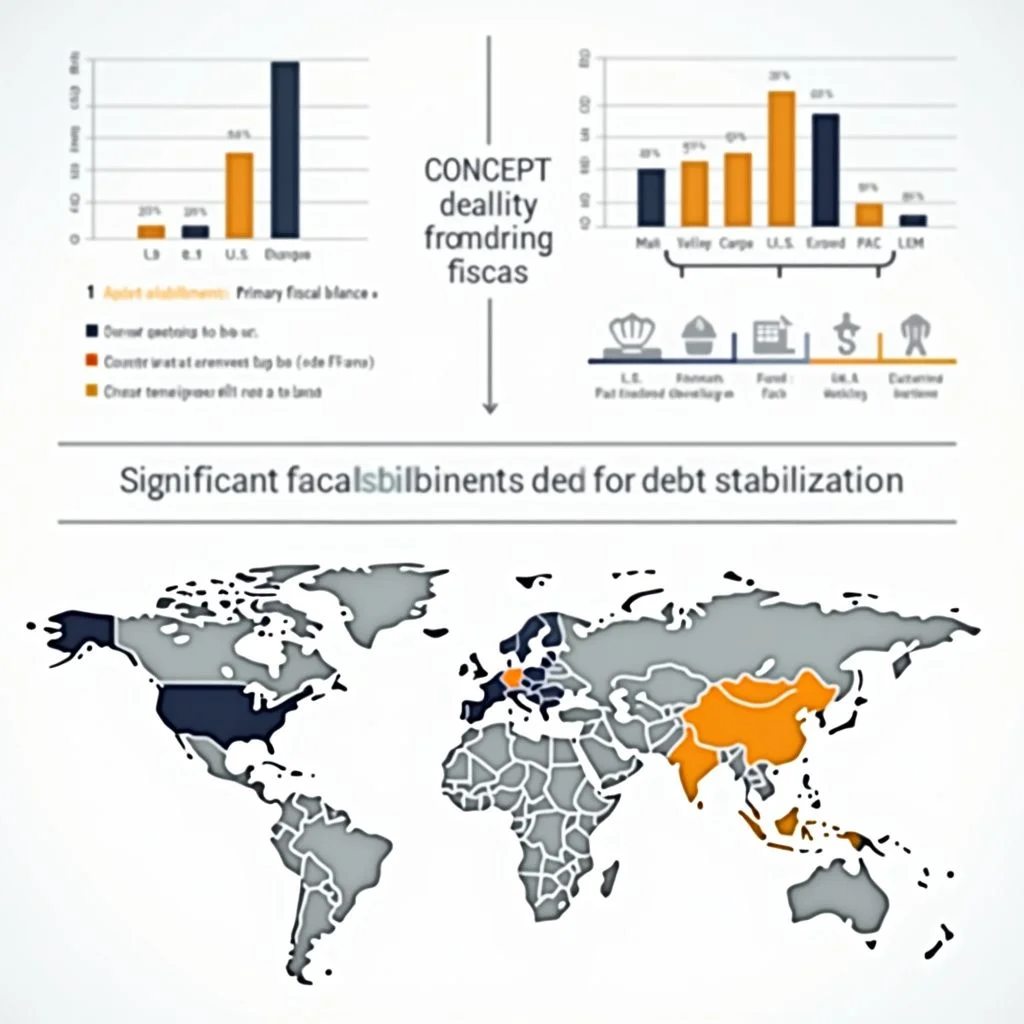
Debt stabilization is a critical issue across advanced economies, with many facing significant fiscal adjustments and increased vulnerability to market shifts. This analysis focuses on the prospects for debt stabilization in the countries of the European Union, the United Kingdom, and the United States. Two methodologies are employed to assess these prospects.
First, the structural primary balance required to asymptotically stabilize the debt ratio with a 70 percent probability is estimated. This involves assessing the plausibility of achieving this level over the medium term, using both historical benchmarks and stochastic forecasts centered on International Monetary Fund (IMF) projections. Second, fiscal reaction functions are estimated to measure the response of the primary balance to changes in the debt level.
The findings reveal several key points. Firstly, the debt-stabilizing primary balances are generally within historical precedents, typically well below 3 percent of GDP. This indicates that the required adjustments are not unprecedented and fall within the range of past fiscal policies. Secondly, the fiscal adjustment needed to reach these debt-stabilizing primary balances is substantial in several countries. Specifically, the United States, France, the United Kingdom, Slovakia, Poland, and Romania must increase their primary fiscal balances by over 5 percentage points of GDP. This highlights the significant fiscal effort required to stabilize debt in these economies.
Thirdly, the feedback coefficient from debt to the primary balance remains positive in all countries. However, this coefficient has significantly declined since the global financial crisis and is not significantly different from zero in most countries. This suggests that the responsiveness of fiscal policy to debt levels has weakened, potentially complicating efforts to stabilize debt.
The overall conclusion is that public debt in the sampled countries remains sustainable in the sense that the required fiscal adjustment to stabilize the debt is feasible. However, achieving this stabilization will necessitate a larger and/or more protracted fiscal effort than has been typical for most advanced countries. Additionally, it exceeds current expectations set by the IMF. In the interim, countries with large adjustment needs could be particularly vulnerable to shifts in market sentiment. This vulnerability underscores the importance of timely and effective fiscal policies to mitigate potential economic risks.
The analysis underscores the importance of understanding the structural primary balance, which is the primary balance adjusted for the economic cycle. This measure provides a clearer picture of the underlying fiscal health of an economy by stripping away the effects of short-term fluctuations. By focusing on the structural primary balance, policymakers can better assess the long-term sustainability of public debt and design more effective fiscal policies.
The stochastic forecasts, centered on IMF projections, provide a probabilistic approach to estimating the required structural primary balance. This method accounts for the uncertainty and variability inherent in economic forecasts, offering a more robust assessment of the fiscal adjustments needed to stabilize debt. Historical benchmarks serve as a valuable reference point, providing context for the magnitude of the required adjustments relative to past fiscal policies.
Fiscal reaction functions offer insights into how governments respond to changes in debt levels. The positive feedback coefficient indicates that countries generally adjust their primary balances in response to rising debt levels. However, the decline in this coefficient since the global financial crisis suggests a reduced sensitivity to debt, which could hinder stabilization efforts. This weakening of the fiscal response to debt levels is a concerning trend, as it implies that countries may be less proactive in addressing debt issues.
The substantial fiscal adjustments required in several countries highlight the need for comprehensive and coordinated policy measures. For instance, the United States, France, the United Kingdom, Slovakia, Poland, and Romania face significant challenges in increasing their primary fiscal balances by over 5 percentage points of GDP. These adjustments will likely involve a combination of revenue increases and expenditure cuts, requiring careful planning and implementation to minimize economic disruption.
The vulnerability of countries with large adjustment needs to market sentiment shifts underscores the importance of maintaining investor confidence. Market sentiment can be influenced by a variety of factors, including economic indicators, political stability, and global economic conditions. Countries with high debt levels and large adjustment needs must manage these factors carefully to avoid adverse market reactions, which could exacerbate their fiscal challenges.
In summary, while public debt in the sampled countries is sustainable, achieving stabilization will require substantial and sustained fiscal efforts. Policymakers must navigate the complexities of fiscal policy, market sentiment, and economic uncertainty to effectively manage debt levels and ensure long-term fiscal health. The use of structural primary balances, stochastic forecasts, and fiscal reaction functions provides a comprehensive framework for assessing and addressing debt stabilization challenges.