Employer-sponsored education assistance is a well-established perk, with tax benefits under Section §127 of the federal tax code allowing employers to deduct up to $5,250 in education assistance per employee annually. These benefits, which cover tuition, fees, and books, were initially renewed every five years but were made permanent in the tax code in 2012. The One Big Beautiful Bill Act (OBBBA) further updates these provisions, making the $5,250 benefit inflation-adjusted starting in 2026. Employers can also offer tax-free student loan repayment assistance under a §127-qualified educational assistance program, a provision now made permanent under OBBBA.
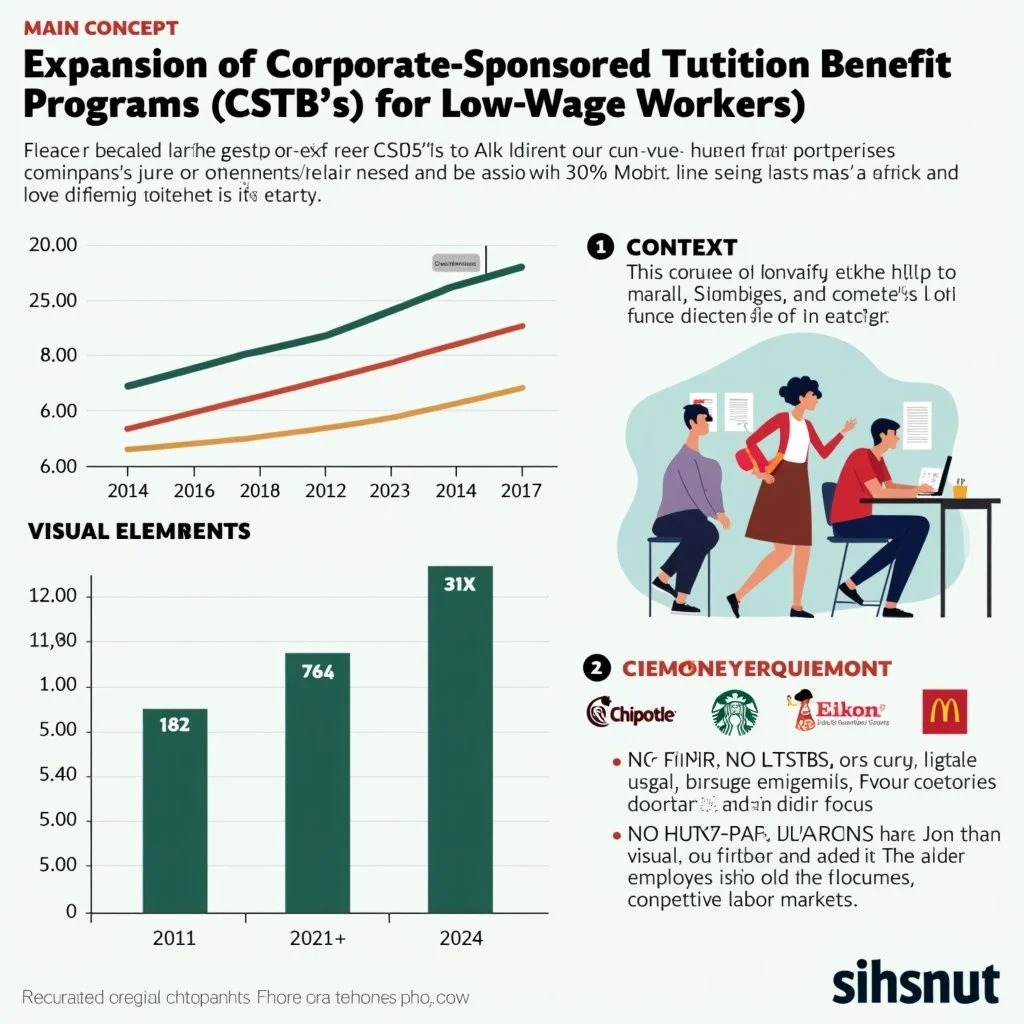
Historically, education assistance has been more common among managerial and executive employees. However, recent research has documented an expansion of these programs to include low-wage workers. Focusing on the 50 largest low-wage employers, primarily in the fast food and retail industries, it was found that none had corporate-sponsored tuition benefit programs (CSTBs) for frontline, non-executive workers prior to the 2012 tax code change. By 2024, 22 of these employers had introduced CSTBs, collectively employing over 4.5 million workers across more than 100,000 locations.
The expansion of CSTBs can be attributed to several factors. These programs may serve as a strategy to recruit and retain workers in a competitive low-wage labor market. Research indicates that corporations offering tuition assistance programs experience lower employee turnover and higher performance ratings among participants. Higher retention rates can lead to significant cost savings for corporations. Additionally, CSTBs may reflect a shift in corporate social responsibility, addressing the rising cost of college and the burden of student loan debt, especially in light of declining public support for higher education following the 2008 recession.
However, there are tradeoffs to private sponsorship of college benefits. Employers can dictate higher education pathways and possibilities, potentially limiting the choices available to employees. A new study investigates these tensions by exploring the design features of CSTB programs and their implications for college access.
CSTBs could significantly benefit the nation’s estimated 53 million low-wage workers, who are individuals earning less than two-thirds of the median full-time male worker wage. These workers, comprising 44% of the total workforce, are primarily employed in part-time service jobs in the fast-food and retail industries. Seventy-seven percent of low-wage workers have not completed a college degree, but CSTBs could make higher education more attainable. If an employer offers the maximum tax-free assistance of $5,250, this amount exceeds the average published full-time tuition and fees at a two-year college. Reports indicate that these benefits are being utilized: for example, Walmart’s Live Better U program has seen over 126,000 associates participate, and the Starbucks College Achievement Program has helped over 16,000 employees earn college degrees since its 2014 launch.
The design of college access programs has significant implications for student outcomes. The study compiled and compared the characteristics of the 22 CSTB programs adopted among the nation’s 50 largest low-wage employers. Eligibility, benefit structures, and performance requirements varied widely across employers. For instance, half of the programs extended benefits to new employees on their first day of work, while about one-third were only accessible to full-time employees. Eleven programs emphasized “debt-free” college, covering 100% of costs in select programs, while others capped benefits at various levels. About 70% of the CSTBs restricted the degree programs and fields in which students could enroll, often focusing on business and management programs. Additionally, about one-fourth of programs had employee performance requirements, and 40% had academic performance requirements. Roughly 60% of programs required students to enroll in online programs, typically through exclusive partnerships with specific institutions, including some for-profit institutions. Over 75% of CSTBs were offered in partnership with third-party providers, such as education technology companies, who provide platforms for employees to access college programs.
Types of CSTB Models
Using a qualitative method for typology analysis, the study identified three types of CSTB models:
1. Employer-Centered CSTB, “Upskilling and Retaining Full-Time Workers”
These programs were restricted to full-time employees and used the tuition reimbursement model, where students pay upfront and later get reimbursed. These programs are primarily beneficial for employers seeking to retain and upskill full-time employees but can be costly and potentially discouraging for employees (n=7).
2. Employer-Designed CSTB, “College, our way”
These programs were offered to both full- and part-time employees. The company sponsored college enrollment upfront but restricted students to online-only programs and typically had restrictions on institutions and degree programs. These programs offer opportunities for upskilling part-time employees in areas that will ultimately serve the employer (n=12).
3. Student-Centered CSTB, “Supporting college enrollment choices”
These programs were offered to both full- and part-time employees with few restrictions on instructional modality and eligible degree programs. These are the most student-centered because they offer the most choice to students while also being accessible to most employees (n=3).
La variación entre los CSTBs refleja las tensiones inherentes en ofrecer programas de asistencia educativa. Si bien algunos empleadores tienen restricciones significativas en la elegibilidad y las opciones de programas, otros ofrecen más flexibilidad. Estas opciones en el diseño de los programas subrayan los objetivos en cierta medida contradictorios de los CSTBs: buscan satisfacer las líneas de base corporativas mientras también mejoran la adquisición educativa y la movilidad social para los trabajadores estadounidenses.
Impacto de los CSTBs en la educación
La proliferación de CSTBs para trabajadores de bajos ingresos durante un tiempo de discusión nacional sobre los costos de la universidad, la accesibilidad y la liberación de la deuda estudiantil invita a una investigación más profunda. Las preguntas clave incluyen si los beneficios fiscales federales para la educación asistida por empleadores son la mejor manera de cumplir con los objetivos nacionales de adquisición de la universidad y si diferentes enfoques de los CSTBs llevan a resultados variados para los empleados y los estudiantes. Muchos programas “Nuestra Universidad a la Manera” se asociaron con colegios privados, que, si bien pueden ser más accesibles, tienen tasas de completación bajas y han sido descritos como predecibles. Si los CSTBs inducen a los empleados a inscribirse en programas de baja calidad, podría dejar a los empleados peor financiera.
Investigación y resultados
La investigación debe continuar estudiando los CSTBs e investigando su impacto en la oportunidad educativa y los resultados, las trayectorias de carrera a largo plazo y la movilidad socioeconómica, y la calidad de vida general para los trabajadores de bajos ingresos. Estos programas de asistencia educativa tienen el potencial de expandir significativamente el acceso a la universidad y promover el éxito universitario para millones de estadounidenses, particularmente aquellos en el trabajo de bajos ingresos. Sin embargo, también es importante reconocer que alrededor del 60% de los empleadores de bajos ingresos más grandes no introdujeron un CSTB a pesar de las exenciones fiscales federales.
Cambios en el mercado laboral de bajos ingresos
Significativos cambios en el mercado laboral de bajos ingresos, debido a cambios en el salario mínimo, la automatización creciente, el cambio de la cultura del consumidor y la cierre de varios minoristas y cadenas, también están afectando las oportunidades de empleo y el acceso a la educación superior para los individuos en el margen de la universidad y el trabajo de bajos ingresos. Los beneficios de la matrícula corporativa son una fuente creciente pero poco estudiada de inversión privada en la educación y el desarrollo de la fuerza laboral. En estos esfuerzos, el mundo corporativo y el mundo de la educación pueden aprender el uno del otro sobre qué funciona para los estudiantes y apoyar la diversidad de estudiantes universitarios, incluidos estudiantes universitarios que trabajan.