Eighty years ago, with the Trinity experiment, humanity entered the atomic age. This event marked the beginning of a story of power, secrecy, and global consequences. The Secretary of War brought the message of the nuclear test’s success to President Henry Truman. General Leslie Groves, director of the Manhattan Project, described the explosion as a success beyond the most optimistic expectations. Twenty-one days later, a similar bomb was dropped on Hiroshima, officially inaugurating the nuclear age.
The Trinity test was not a random event. Truman was in Potsdam, where the conference that would establish the new post-World War II order had begun. Having become president only three months earlier, after the death of Franklin Roosevelt, Truman lacked the experience and charisma of his predecessor. Many considered him unfit for the role and too weak to face Stalin. However, the message from General Groves gave him a unique power: he possessed the ultimate weapon. Winston Churchill noted that Truman was a changed man.
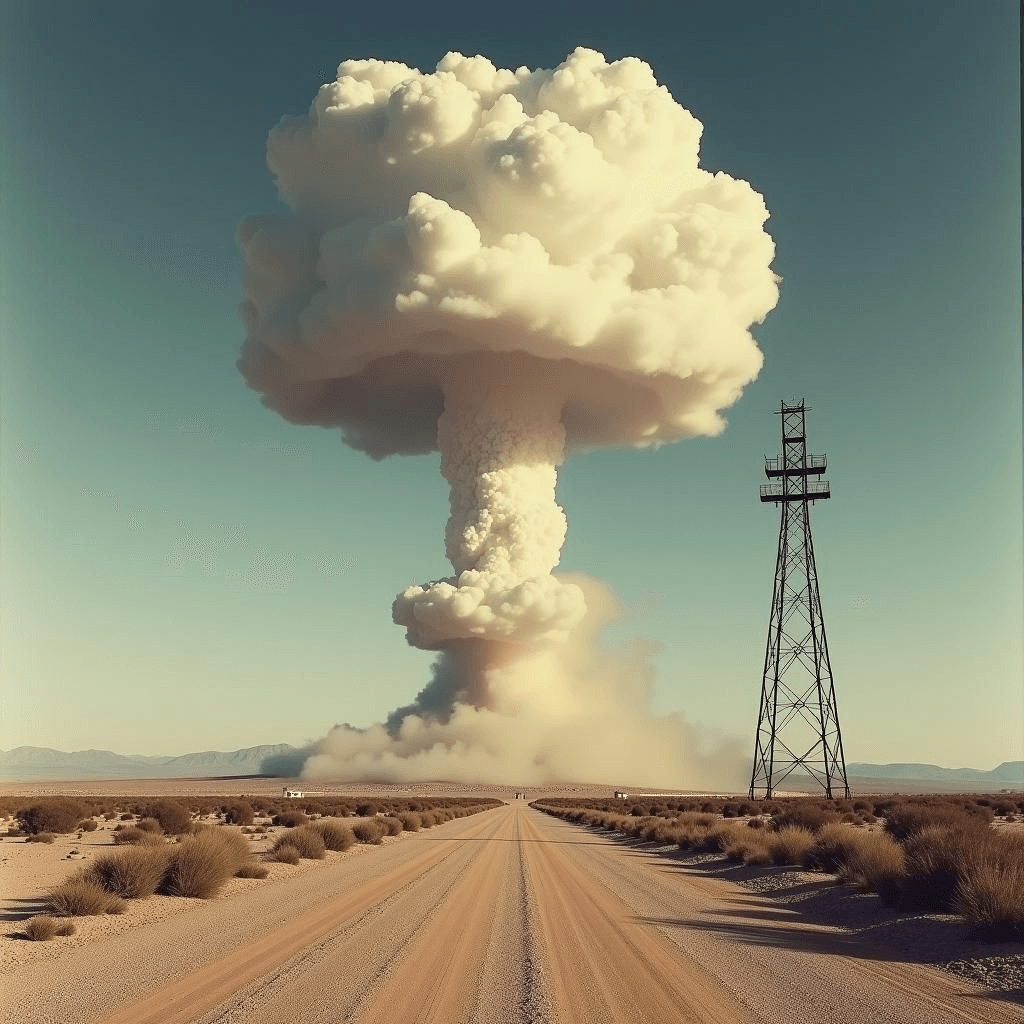
The Trinity test represented the decisive and most dangerous step of the Manhattan Project, the ultra-secret plan to build the atomic bomb. If it had failed, the project would have suffered a significant delay, influencing the end of the war in Asia. After evaluating eight sites in the United States, the scientific director of the project, Robert Oppenheimer, and his team of scientists, including Enrico Fermi and Emilio Segré, chose the Alamogordo desert. Specifically, a depression called Jornada del Muerto, “the journey of the dead,” was selected for its isolation, ensuring the secrecy of the experiment. Emilio Segré explained that the test consisted of the explosion of an atomic bomb containing plutonium-239, placed atop a steel tower, with the goal of measuring the energy released in various forms: light, gamma rays, shock wave, etc.
The explosion occurred at 5:30 AM on July 16, 1945, just before dawn. The scientists were not certain of what would happen. They thought the explosion would create a mushroom cloud 3,700 meters high, but the 21-kiloton bomb, equivalent to 15,000 tons of TNT, generated a mushroom cloud 15,000 meters high. The heat released was ten thousand times that of the solar crust. Oppenheimer defined himself as Vishnu, the destroyer of worlds. Secrecy was essential: the Japanese and the Soviet ally should not know. In reality, a spy for Stalin, the physicist Klaus Fuchs, was already infiltrated among the project’s scientists. Secrecy was such that General Groves did not evacuate thousands of civilians who would be affected by the nuclear fallout. Nearly half a million people lived within a 150-mile radius of the explosion site, some just 12 miles away. It was not until 1990 that Congress approved the Radiation Exposure Act to compensate 22,220 people defined as “Downwinders.” In 2006, the Department of Energy defined Trinity as “the most significant gamble of the entire Manhattan Project.”
At the Potsdam conference, next to the conquered and destroyed Berlin, Truman felt like the strongest man in the world. However, this feeling was short-lived. In 1949, the Russians conducted their Trinity at the Semipalatinsk test site in the Kazakh desert. From that moment on, the United States and the Soviet Union began a nuclear arms race that by 1985 had surpassed 60,000 warheads, although only a few dozen would have been sufficient to destroy the Earth. Deterrence, diplomatically defined, has prevented a thermonuclear war. The best explanation is the acronym MAD – Mutually Assured Destruction. Anyone who launched their bombs knew that the enemy, before being annihilated, would have had time to launch theirs.
Today, Russia and the United States each possess about 5,000 warheads, but continue to invest astronomical sums in nuclear rearmament, no longer in quantity but in technology. Treaties provided for a progressive reduction to 1,500 warheads each, but they are now mere scraps of paper, given the tension between the two countries. Last year, Vladimir Putin threatened the use of the atomic weapon in Ukraine, violating a taboo of the atomic age. Meanwhile, China silently multiplies its arsenal to reach American and Russian quantities and quality. France and Britain propose to guarantee the nuclear umbrella to a Europe that Donald Trump wants to abandon, while strengthening their American arsenal. Iran is not the only country that ambiguously aspires to build the bomb, because in this increasingly Hobbesian world, having it is better: its deterrent capacity guarantees national security.
This is the world we inherited from the blinding explosion of Trinity, at dawn on July 16, 1945, in the desert called Jornada del Muerto.