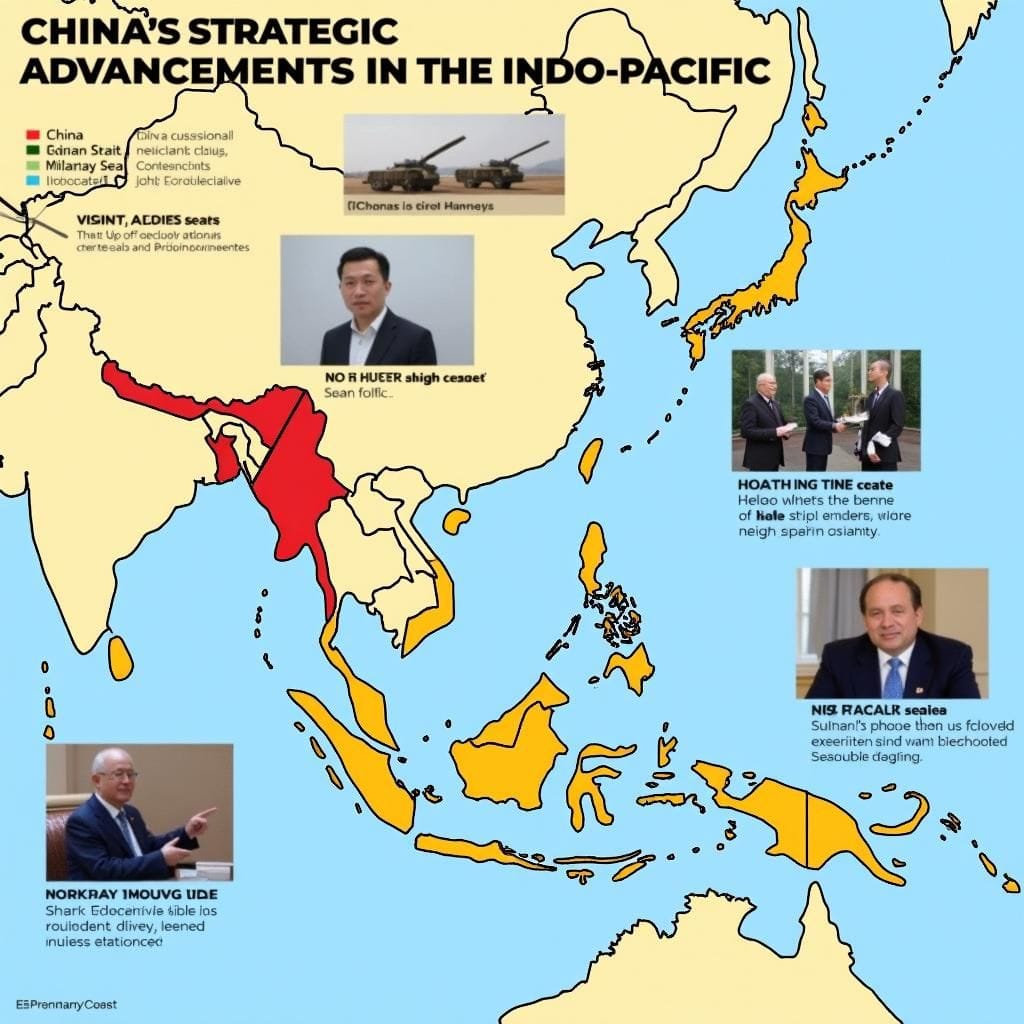
While the Trump administration has been engaged in a trade war with Beijing, China has implemented a two-pronged strategy to strengthen its position in the Indo-Pacific region. This approach involves intensifying pressure on countries that challenge China’s sovereignty claims while simultaneously drawing closer its key partners and swing states.
Notably, in April, China made its first on-the-ground, formal assertion of sovereignty over a previously unoccupied land feature in the South China Sea in over a decade. Concurrently, Beijing has increased pressure on Taiwan, particularly during its Strait Thunder-2025A exercise in April.
These actions are likely intended to establish a new baseline for Beijing’s coercive activities during the Trump administration.
Simultaneously, China has pursued a charm offensive with friendly countries and swing states in Southeast Asia.
This dual strategy is driven by several factors. President Donald Trump and his top foreign policy officials are preoccupied with multiple fronts, including the trade war, strikes on Iran, and efforts to resolve conflicts in Ukraine and the Middle East.
This distraction is compounded by a lack of staffing to address Beijing’s subtle territorial advances.
Moreover, Chinese Foreign Minister Wang Yi expressed concern that the United States would shift its full attention to China and the Indo-Pacific after the end of the Ukraine war, prompting Beijing to consolidate its position in the region sooner rather than later.
The Trump administration’s erratic tariff policies provide an opening for China to make inroads with countries in the region at minimal cost.
The administration’s focus on trade and technology issues has distracted it from pushing back on Beijing’s coercive activities against U.S. allies and partners, allowing China to advance its interests unchecked.
The prospect of an in-person meeting between Trump and President Xi Jinping is likely to further dampen the administration’s response to Beijing’s provocations.
For example, the Trump administration blocked Taiwan’s President Lai Ching-te from transiting New York to avoid irritating Beijing.
The administration’s lack of response to Beijing’s actions has given China little reason to change course.
Washington’s silence is likely to invite further intensification of both China’s coercive activities and its efforts to woo the region, allowing Beijing to enhance its strategic position at the U.S. expense.
If the administration continues to focus more on pressuring U.S. allies and partners than supporting them, Beijing is poised to reap further gains.
One week after Trump’s tariff hikes on April 2, Xi and the Politburo Standing Committee convened an unusual Central Conference on Work Related to Neighboring Countries.
This conference provided a crucial forum for Xi to outline his plans for strengthening China’s position in the Indo-Pacific for the second Trump administration.
The conference was unlikely to have been a direct response to the Trump administration’s tariffs, as such conferences typically require months of preparation.
However, it was designed to provide updated guidance on handling the region during the second Trump administration.
The last similar conference was held in October 2013, shortly before China pivoted to a more assertive approach to its sovereignty claims in the South China Sea.
This conference marked a shift away from the “hide and bide” foreign policy that had governed China’s actions since the Tiananmen crackdown.
China’s “periphery” has been a key part of its foreign policy since 1987, when the concept of “peripheral environment” appeared for the first time in The People’s Daily.
Xi’s 2013 conference elevated the importance of this concept, and the most recent conference in April further augmented the role of peripheral diplomacy in China’s overall foreign policy.
In his speech, Xi emphasized the need for China and its neighbors to “deepen development integration, build a high-level interconnection network, and strengthen industrial chain and supply chain cooperation,” likely in response to Trump’s tariffs.
Days after the conference, Xi called Indonesian President Prabowo Subianto on the 75th anniversary of China-Indonesia relations and embarked on a tour of Cambodia, Malaysia, and Vietnam.
The following month, Premier Li Qiang, a close Xi ally, visited Indonesia and met with Prabowo.
He also attended a summit between ASEAN, China, and the Gulf Cooperation Council in Malaysia.
These countries are key swing states in Southeast Asia, known for hedging between great powers.
Xi deliberately targeted these neighboring states by making them his first foreign visit after the U.S. tariffs were imposed.
These countries have deep trade relations with China and a track record of supporting Chinese companies during the first trade war.
They are also appreciative of free trade policies.
After the United States pulled out of the Trans-Pacific Partnership and enacted protectionist policies during the first Trump administration, these Southeast Asian states began to see China as the preeminent economic power in the region.
Beijing is recapitulating its playbook from the first trade war by capitalizing on this moment of increasing U.S. protectionism to posture as these states’ most reliable economic power. For its own sake, Beijing wants to strengthen its trade relations with these countries to bolster its ability to withstand Trump’s tariffs as the trade war potentially intensifies. Beijing is specifically targeting ASEAN countries to build up a new market for its exports.
Since January, China has not advanced significant new initiatives in the region, beyond symbolic gestures like head of state visits and the signing of new memorandums of understanding. The Chinese leadership’s official assessment at its April conference was that “at present, China’s relations with neighboring countries are at their best in modern times.” Given this favorable assessment, Beijing likely judges that it does not need to offer much more to pull countries closer.
Xi’s policy reflects his likely calculation that the United States is making mistakes in managing its allies and partners in the region and does not want to expend any resources wooing them until the dust has settled.
Beijing’s Charm Offensive
Beijing’s charm offensive is only part of the story in its approach to Southeast Asia. Beijing almost always tests new U.S. administrations’ commitment to its allies and partners in the region during the first year.
China’s assertion of sovereignty over Sandy Cay in April looks like just such an opening gambit. Notably, China’s move came just weeks after Secretary of Defense Pete Hegseth visited the region and reiterated the United States’ “ironclad commitment” to the Philippines alliance.
Shortly after that visit and just ahead of Balikatan 2025, the annual joint military exercise between the Philippines and the United States, the Chinese Coast Guard unfurled a flag on Sandy Cay in the northern Thitu Reefs of the Spratly Islands in the South China Sea.
Although this move did not create new facts on the ground, it laid the groundwork for Beijing to make bigger muscle movements not just at Sandy Cay but also around nearby Thitu.
Thitu lies so close to Sandy Cay that their territorial seas overlap, meaning that a Chinese claim to Sandy Cay introduces a competing claim into the waters around Thitu.
This year’s Balikatan exercise was actually smaller than in recent years, and previously, the Chinese Coast Guard only responded through statements and an increased ship presence in the South China Sea.
It is possible that some unreported incident on the water prompted Beijing’s action, but the situation at Sandy Cay seems similar to Beijing’s probing of the U.S. commitment to the Philippines early in the Biden administration.
In March 2021, shortly after Biden’s inauguration, more than 200 Chinese vessels were moored at Whitsun Reef, a feature within a Philippines-claimed feature that is within its exclusive economic zone (EEZ).
The Biden administration responded with a series of cabinet-level engagements with the Philippines, issued public and private statements that China’s actions near Whitsun Reef were “impeding the lawful rights” of the Philippines, and called on China “to stop using its maritime militia to intimidate and provoke.”
The U.S. State Department spokesperson that month said the United States stands with the Philippines against the People’s Republic of China’s (PRC) maritime vessels near Whitsun Reef, and former National Security Advisor Jake Sullivan called his Philippine counterpart to discuss shared concerns.
The following month, then-Secretary of State Antony Blinken called Philippines Foreign Minister Teodoro Locsin, Jr., to share concerns over China’s actions.
The Chinese vessels dispersed over the ensuing weeks.
Sandy Cay Incident
In the case of Sandy Cay, Beijing’s bet was well-placed. Three months after the incident in April, the Trump administration has registered little to no public response to the flag planting, beyond White House National Security Council Spokesperson James Hewitt initially saying, “The reports of China seizing Sandy Cay reef are deeply concerning, if true.”
Beijing likely interpreted the lack of response on the water or comment from a cabinet-level official as a green light to keep pressing its claim.
Indeed, just a month later, in May, China water-cannoned Philippine vessels operating in the vicinity of Sandy Cay.
In late May and early June, during regular meetings with their Filipino counterparts, both Secretary of State Marco Rubio and Hegseth condemned Beijing’s destabilizing behavior in the South China Sea, but they did not specifically mention Sandy Cay.
In fact, there was not even a single press release or press briefing comment regarding Beijing’s behavior.
During Hegseth’s Shangri-La Dialogue speech at The International Institute for Strategic Studies in late May, he called out China’s harassment of its neighbors and made an overture to the ASEAN defense leaders in the audience: “China seeks to intimidate you in your own waters.”
Most recently, Rubio made a statement on the ninth anniversary of the Philippines-China South China Sea Arbitral Tribunal Ruling, calling on China to abide by the 2016 ruling and “cease its dangerous and destabilizing conduct.”
These comments would have been made regardless of Beijing’s recent actions in the South China Sea-and Beijing knows this.
Beijing was trying to see if the United States would respond in any meaningful way to its salami-slicing behavior-and it did not.
Although Beijing considers Taiwan part of China rather than its periphery, similar dynamics vis-à-vis the United States seem to be animating China’s approach to the Lai administration. China is likely probing how hard it can pressure Taiwan under the Lai administration-which Beijing loathes-before eliciting a U.S. response. So far, the Trump administration has not had a discernible response to PRC activities in the Strait, even though Beijing has lowered its threshold for undertaking large-scale exercises around Taiwan over the past several years.
Beijing’s push-and the lack of U.S. pushback-could result in Beijing establishing a new normal for its military activities around Taiwan during the Trump administration. The most recent significant activity came in early April with the Strait Thunder-2025A exercise. This was one of Beijing’s largest exercises to date, with 135 aircraft sorties and more than 30 vessels surrounding the island. This exercise was on par with Beijing’s October 2024 Joint Sword-2024B exercise, which was just below the scale of the exercises after then-Speaker of the House Nancy Pelosi’s visit to Taiwan.
Beijing launched Strait Thunder in response to the Lai administration labeling China a “foreign hostile force” and ramping up anti-espionage forces in mid-March. Although the escalating tit-for-tat dynamic between China and Taiwan has a logic of its own, the possibility of a U.S. response is always part of Beijing’s calculation on Taiwan issues.
Yet again, the Trump administration’s response to the exercises was minimal, with no public response from the Department of Defense and a one-line response from the State Department spokesperson, who said that “China’s aggressive military activities and rhetoric toward Taiwan only serve to exacerbate tensions and put the region’s security and the world’s prosperity at risk.”
So far, the Trump administration has announced no arms sales in 2025, despite rumors of consideration within the administration, and instead has only issued demands for Taiwan to increase defense spending.
The Trump administration’s quiescence in response to the PRC’s regional provocations and diplomacy is a departure from its initial actions.
In its first 100 days, the Trump administration made some laudable early moves to send reassuring signals to allies and partners in the Indo-Pacific. These initial overtures included convening a Quad foreign ministerial meeting one day after Inauguration Day, followed by early visits from key regional partners. Notably, even as Vice President JD Vance was excoriating U.S. European allies at the Munich Security Conference in February, Secretary of State Marco Rubio was holding a trilateral meeting with his Japanese and Republic of Korea counterparts.
Secretary of Defense Pete Hegseth’s visits to the region likewise conveyed a reassuring message.
Nevertheless, the administration’s preoccupation with wars in the Middle East and Europe and its view that allies and partners are more liabilities than assets likely blunted the effect of this initial diplomacy in the region.
The tariffs unleashed on Liberation Day probably undid much, if not all, of the hard work that went into that initial-and still very much inchoate-regional diplomacy and gave ample room to Beijing to undermine allies’ faith in the U.S.’s reliability.
Signs of unease among allies and partners in the Indo-Pacific are already beginning to mount in response to the administration’s actions.
Australia is anxious about the Trump administration’s announcement that it would review the trilateral Australia-U.S.-U.K. security initiative known as AUKUS, which comes on the heels of the Trump administration’s inactivity in the face of an unprecedented People’s Liberation Army Navy live-fire drill in the Tasman Sea near Australia in February.
Trump again threatened to escalate tariffs to 25% against key allies South Korea and Japan in July because they would not acquiesce to his demands, prompting Japanese Prime Minister Shigeru Ishiba to publicly muse about Japan’s need to wean itself from the United States in key areas.
Beijing is indeed testing the new administration’s commitment to allies and partners in the region-and it has likely found the results to be reassuring.
It may not be too late for the administration to recalibrate Beijing’s expectations, but it will require more than just Secretary of Defense Pete Hegseth attending the Shangri-La Dialogue-which in Southeast Asia is just table stakes.
It will require focus and follow-through that so far have been lacking, as the trade war and international hotspots like the Middle East seemingly have consumed the Trump administration’s bandwidth.
More recently, the administration, to its credit, hosted Philippine President Ferdinand Marcos for a series of meetings and reaffirmed the U.S. commitment to their mutual defense treaty in the South China Sea.
But dissuading Beijing from further escalation will also require tangible actions such as continued arms sales to Taiwan, as well as Taiwan Strait transits and freedom of navigation operations in the South China Sea.
The administration could also respond asymmetrically to Beijing’s provocations by employing its economic tools.
By themselves, these actions have never deterred China in the past and are unlikely to do so moving forward. But Beijing will interpret their absence in the wake of these provocations as a green light to keep salami slicing across the region.
In the absence of U.S. pushback, the only limiting factors on Beijing’s coercion will be the twin dynamics of the region’s ingrained skepticism about Beijing and Beijing’s desire to preserve a façade of amity with its neighbors.
It will take time to marshal other options for dealing with Beijing’s coercion, but in the meantime, a distracted Trump administration risks defaulting to a “reverse Roosevelt” in the Indo-Pacific by speaking loudly about U.S. power in the region and wielding a small stick.