Elementary and secondary schools play a crucial role in preparing young people for higher education, the labor market, and active citizenship. Quality education is also a significant driver of innovation and economic growth. Improving schools, particularly for children in low-income families or disadvantaged communities, has been a long-standing policy goal. A key debate in recent decades has focused on whether additional funding alone, without changes to incentives, institutions, and regulations, can improve student outcomes.
Early studies, such as the Coleman Report in 1966, suggested a weak relationship between spending and educational outcomes. This led to the academic literature framing the issue as “Does money matter?” However, this framing is imprecise. Both proponents and skeptics of increased spending agree that schools need money to function effectively. More recent research has shown that, on average, additional funding does improve educational outcomes. However, the extent and conditions under which money affects outcomes, and whether other approaches might be more effective, remain open questions.
The intuitive appeal of increased funding is evident in addressing issues like crumbling infrastructure, lack of supplies, understaffing, and overcrowding. Modern studies do show positive effects of school spending, but these effects are often small and sometimes negligible. Substantial increases in per-pupil spending have not always led to improved academic achievement, raising questions about other barriers to school improvement, such as staffing rules, teacher pay, curriculum standards, and incentives for schools and students.
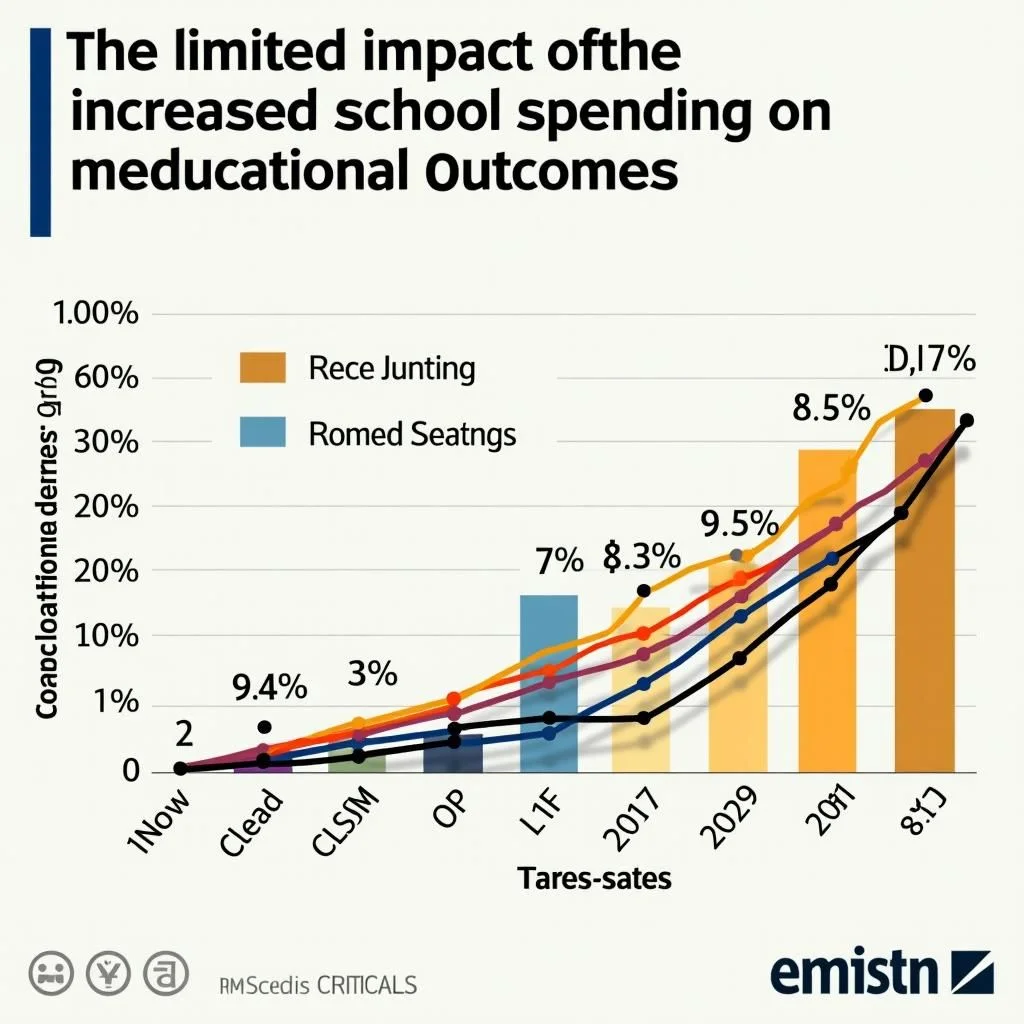
Policymakers and advocates must decide whether to focus primarily on increasing funding or on other reforms. While these options are not mutually exclusive, policy and research attention are limited. This question is particularly important for state policymakers, as state governments play a crucial role in school funding. Figure 1 illustrates that differences in average per-pupil spending across states are substantial but not strongly related to average test scores.
To understand this relationship, this report analyzes cross-state differences in spending and outcomes over time. Interpreting cross-sectional input-output relationships is challenging due to variations in student needs and input prices across states. These variables can be correlated with both spending and outcomes, making it difficult to establish a causal relationship. Recent research has focused on addressing this “omitted-variables” problem to estimate the causal effects of spending on educational outcomes.
Despite these challenges, differences in per-pupil spending across states are large and persistent. Schools in the highest-spending states spend two times as much or more compared to those in the lowest-spending states. Increasing per-pupil spending in all states to the average of the highest-spending state would require almost $600 billion, which is significantly larger than existing federal aid for elementary and secondary education. Even increasing spending to the level of the second-highest-spending state would cost about $360 billion.
Focusing on the 2018-19 school year, the last before the pandemic disruption, reveals a weak relationship between per-pupil school spending and educational outcomes as measured by test scores and high school dropout rates. Without controlling for other state characteristics, the spending-outcome slope is about half of the average causal effect of spending on test scores and one-quarter or less as large for high school dropout/graduation. This finding is robust across different test scores, grades, subjects, and whether spending is adjusted for input costs. The small positive slope is largely driven by differences in socioeconomic status across states; controlling for the state poverty rate and/or per-capita income generally reduces the slope close to zero.
The relationship between per-pupil spending and outcomes for economically disadvantaged students is of particular interest. Policymakers are especially concerned with the outcomes of these students. Economically disadvantaged students in higher-income states are exposed to higher school spending compared to their counterparts in lower-income states. Families might increase out-of-school investments when spending is low, but the families of economically disadvantaged students are less able to compensate in this way. However, the relationship between school spending and test scores or high school graduation is, if anything, flatter for more disadvantaged students.
Analyzing the spending-outcome relationship since the early 2000s suggests that the slope may have been steeper in the past and approached the average causal effect. However, controlling for per-capita income and/or poverty reduces that relationship substantially. Overall, average spending varies across states, as do average test scores, but the two are not very correlated. The picture for high school graduation is similar.
Examining how spending choices differ in lower- and higher-spending states reveals that spending is more-or-less scaled up in higher-spending states. The allocation of spending across functional categories is similar across states, and higher-spending states employ more staff across all categories and pay teachers more. Higher teacher salaries in higher-spending states are partially due to higher wages for college-educated workers generally, but higher-spending states also pay more relative to prevailing wages.
Potential explanations for the unexpectedly small relationship between school spending and educational outcomes include differences in how schools use their funding and differences in student needs or input prices. Improving schools is not merely a matter of money, although more money would probably help in some circumstances. Policymakers and researchers should devote as much attention to understanding and improving productivity in education as they do to the level and distribution of funding.
La relación entre gastos escolares y resultados educativos
La relación entre gastos escolares y resultados educativos ha sido objeto de estudio en diversas investigaciones. Aunque se ha encontrado una relación pequeña entre ambos factores, es importante considerar las diferencias en cómo se utiliza el dinero en las escuelas y las necesidades de los estudiantes. Es necesario mejorar la productividad en la educación para lograr mejores resultados.
La relación entre gastos escolares y resultados educativos ha cambiado con el tiempo. En el pasado, se encontraba una relación más clara entre ambos factores. Sin embargo, en la actualidad, la relación es más débil. Esto sugiere que la relación entre gastos escolares y resultados educativos no es tan sencilla como se pensaba.