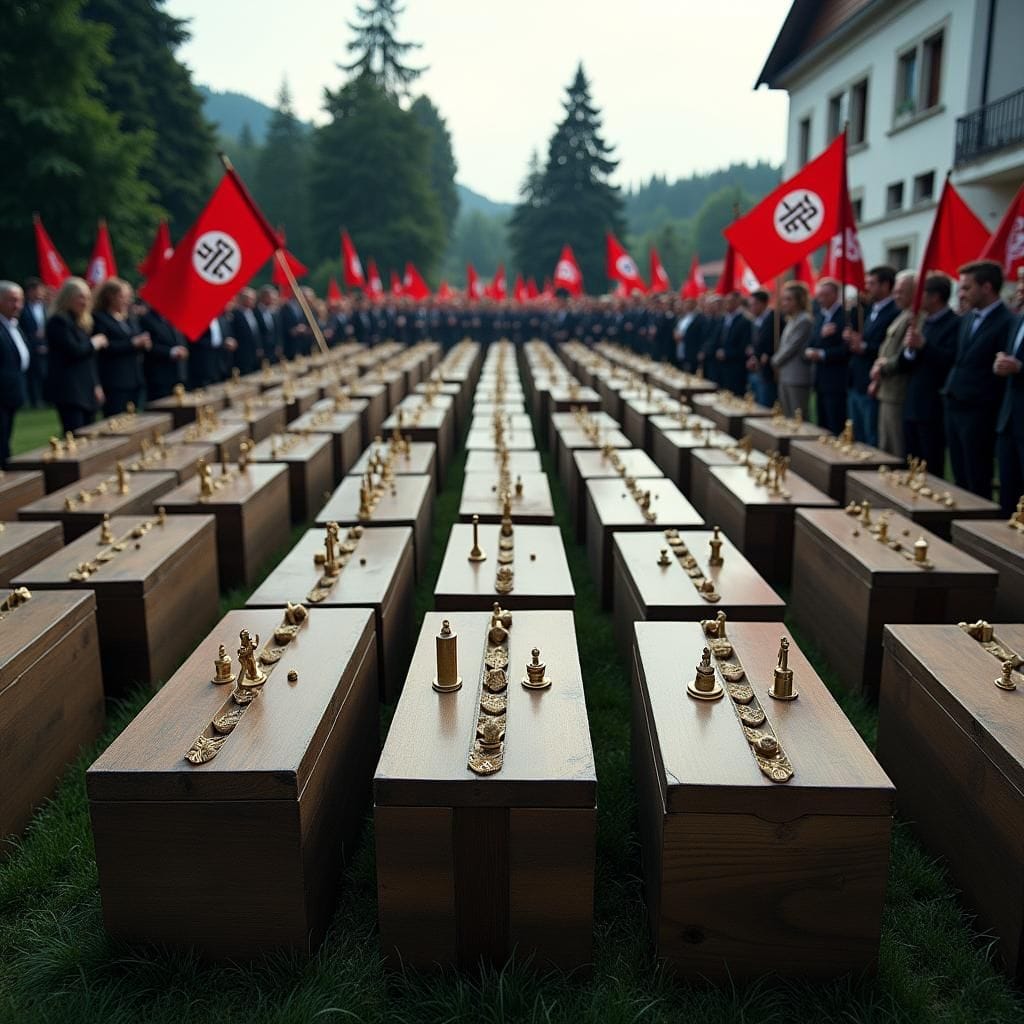
Thirty years after the Srebrenica genocide, its memory remains a subject of dispute between commemoration and denial in an increasingly divided context, where the memory of the massacre is an instrument of political ends. Today marks the thirtieth anniversary of the massacre of more than 8,372 Bosnian Muslims by Serb-Bosnian troops led by Ratko Mladic, who in July 1995 regained control of the Bosnian enclave with a Muslim majority. This is the second anniversary since the UN proclaimed July 11 as the International Day of Reflection and Commemoration of the Srebrenica Genocide in May 2024. On this anniversary, the burial rituals of the victims identified during the year at the Potocari memorial are accompanied by reflections on the situation in Bosnia and Herzegovina, which has long faced institutional paralysis due to secessionism that, in part, has its origins in Srebrenica.
Legal and Political Developments
In 2021, then High Representative Valentin Inzko included the crime of denial of the Srebrenica genocide in the Criminal Code. This measure reignited secession threats from the Bosnian state legal system by Republika Srpska President Milorad Dodik, who has further distanced the Serb-majority administrative entity from central authorities. Another conflict arose in February when Dodik was sentenced to one year in prison and six years of public office interdiction. In retaliation, Dodik approved a series of laws to invalidate the authority of Bosnian judicial and police institutions in the entity’s territory. This triggered a confrontation between Sarajevo institutions and Serb-Bosnian nationalists, exacerbated in March by the arrest warrant issued against Dodik for his refusal to testify before the Bosnian prosecutor’s office in an investigation implicating him in the subversion of the constitutional order. Although the arrest warrant was withdrawn, the paralysis persists.
Bosnia is once again divided over the memory of Srebrenica. This has been a support for Dodik, who uses secessionism to improve his political situation and, every July 11, takes the opportunity to spread denialism that has been the basis of his nationalist career. However, Dodik began his career as a moderate and was the first Serb-Bosnian politician to recognize in 2007 that a genocide occurred in Srebrenica, which earned him the support of Americans and Europeans. This year, the memory of Srebrenica will be even more divided between opposing memories: on one side, the families of the victims, who on this July 11 will see only seven coffins buried. On the other side, those who manipulate, deny, minimize, or even glorify what happened in Srebrenica. The proclamation of the International Day by the UN has provided a new pretext for this manipulation.
While the UN General Assembly voted on the resolution on May 23, 2024, Serbian President Aleksandar Vucic presented himself in a scene of martyrdom, in tears and wrapped in a flag. “It will reopen old wounds and lead to political chaos,” Vucic said then, and although his statement seems to have grounds when observing the current situation in Bosnia, it is important to remember that he himself is one of the main responsible for this chaos. Not only because of the doctrine of the “Serb world,” a softened version of “Greater Serbia” with which Belgrade seeks to politically influence the countries of the region, but also because he has forced a nationalist and nationalist interpretation of the events of Srebrenica and, consequently, of the UN resolution. Although the text of the resolution does not mention either Serbia or the Serb people, Vucic and his followers have promoted the idea that the resolution defines the Serb people as “genocidal.” This is a lesson that has been lost after Srebrenica and that resonates in the current context of international relations: the guilt for crimes is always individual, never collective; sentences condemn generals, heads of state and government, but not the peoples from which they come. Forgetting Srebrenica means forgetting the meaning of justice after such an atrocious crime. No sentence or resolution has attributed national guilt for the events of Srebrenica, whose genocide defines the category of the victims and, therefore, the reason why “the crime of crimes” occurred, but not that of the perpetrators.
In the current context, if the arrest warrant of the International Criminal Court against leaders such as Putin or Netanyahu were executed and sentences of conviction were reached, these would focus exclusively on their political actions, without judging Russians and Israelis as peoples. Only those who support a crime can feel threatened by a sentence against a criminal. In nationalist circles in Serbia and in the Republika Srpska, those who defend the innocence of Mladic and Karadzic are the same who consider the military action that led to the fall of Srebrenica and the beginning of the genocide as a “liberation.”
Memory and Justice
At the same time, if justice is independent of national belonging, memory is even stronger when it comes from those who, in the name of the group in whose name these crimes were committed and justified, oppose the propagandistic narrative. The so-called “traitors of ethnic cohesion” are those who break the propagandistic narrative of their group and do not let themselves be carried away by nationalist politics, but by humanity. Among these are several realities: for example, the Women in Black, who every year remember Srebrenica in silence, challenging nationalist rhetoric in the center of Belgrade; and also the Youth Initiative for Human Rights (YIHR), always in support of international tribunals. In a world where wars and violence against civilians are justified in the name of supposedly unavoidable national interests, the “traitor” of ethnic cohesion remains the best tool both to condemn crimes and to honor the victims.