Candidate countries remain far from European Union averages in terms of GDP per capita and their demographic and labour market characteristics. This analysis examines selected income, demographic, and labour market indicators for nine actual and potential candidates for European Union membership. The country group includes the six Western Balkan countries and three EU Eastern Partnership countries. We assess their distance from the EU average on these indicators and whether the gap has shrunk since 2003, when the EU Thessaloniki Summit offered potential EU accession to Western Balkan countries. We also compare these candidates with the three newest EU member states: Bulgaria, Romania, and Croatia. Despite a shared post-communist legacy, EU candidate countries are not homogeneous. They emerged from distinct historical and economic systems: the Soviet Union, communist Yugoslavia, and isolated Albania. These backgrounds have shaped their economic structures and integration paths, with the post-Yugoslav states and Albania receiving EU accession offers two decades before Ukraine, Moldova, and Georgia. Today, renewed momentum for enlargement is driven by both long-term convergence goals and geopolitical considerations following Russia’s invasion of Ukraine.
Income per capita convergence
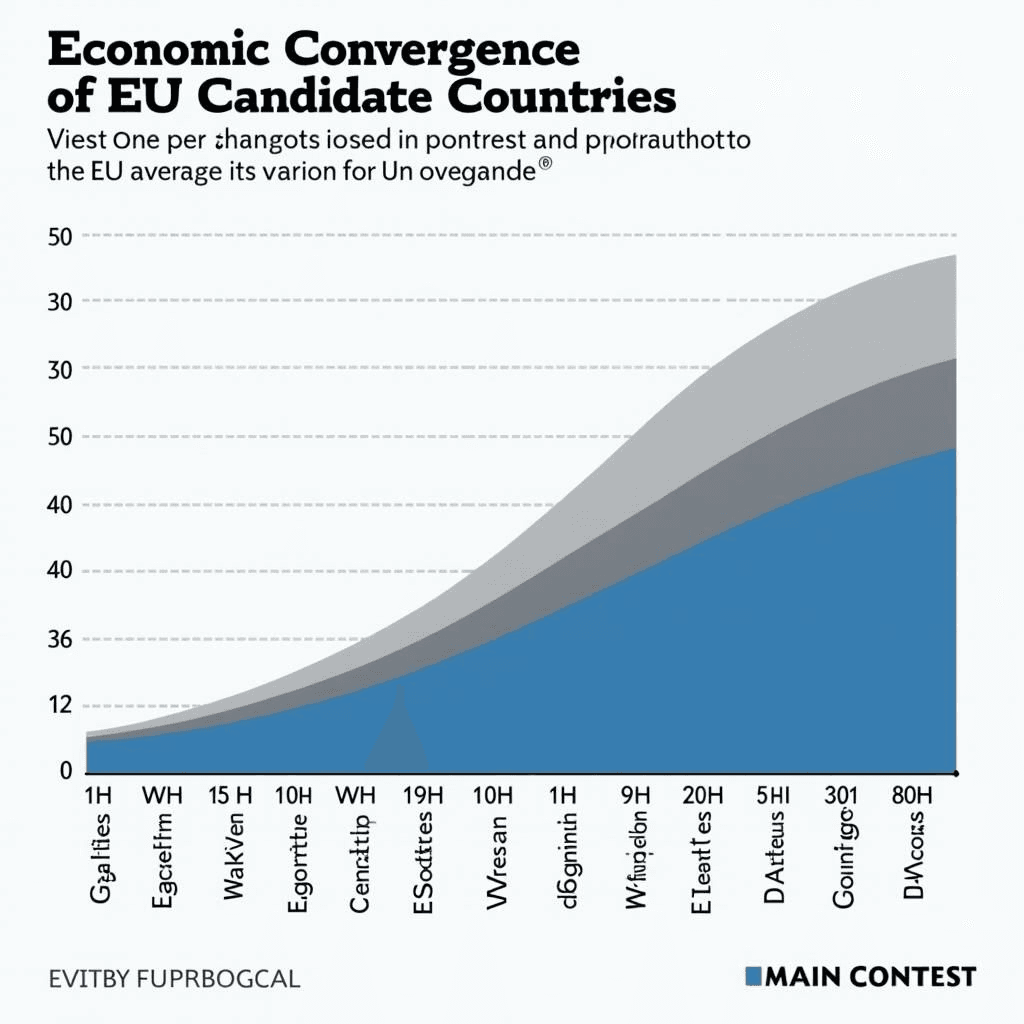
In GDP per capita terms, since 2003, all candidate countries except Ukraine have converged somewhat towards the EU average, but from a low starting level. In 2024, Montenegro and Serbia recorded the highest GDPs per capita, roughly half the EU average, followed by Georgia and North Macedonia. Moldova, Kosovo, and Ukraine had the lowest levels, each around 30 percent of the EU average. Income per capita in Western Balkan countries was higher than in the Eastern Partnership countries, explained by higher starting levels of GDP per capita and faster convergence. Between 2003 and 2024, Georgia progressed most rapidly, followed by Serbia, Albania, and North Macedonia. Kosovo and Moldova also showed significant progress, while Bosnia and Herzegovina and Ukraine lagged behind.
Ukraine is a special case. Between 2003 and 2008, it was among the countries with the highest GDP per capita in the sample. However, it experienced three de-convergence periods due to the global financial crisis, domestic political instability, and Russian aggression. The Western Balkan countries have converged more rapidly with the EU average due to geopolitical circumstances, earlier EU integration processes, and slightly better business and investment climates. These factors resulted in larger inflows of foreign direct investment and more trade with the EU. The rapid GDP per capita convergence of the three newest EU countries suggests EU integration plays a positive role in growth acceleration. Between 2003 and 2024, the gaps between these countries and the Western Balkan countries increased. GDP per capita in Bulgaria and Romania grew by 26 and 30 percentage points of the EU average, respectively.
Significant population declines
Unlike the EU, all candidate countries except for Montenegro have suffered from depopulation. Between 2003 and 2023, Bosnia and Herzegovina’s population declined by 24 percent, followed by Ukraine, Moldova, Serbia, Albania, North Macedonia, Georgia, and Kosovo. The newest EU countries have seen similar trends: Bulgaria lost 18 percent of its population, Romania 12 percent, and Croatia 11 percent. Depopulation is a consequence of declining fertility rates, limited progress in increasing life expectancy, and net outward migration.
Fertility rates in the analysed countries have been converging to the EU level, below the replacement level of 2.1 births per woman. Some countries, particularly Kosovo, Georgia, and Albania, saw delayed fertility rate declines compared to the other countries and the EU. In 2023, the EU candidates with the highest rates were Georgia, Montenegro, and Moldova. All countries, except Ukraine and Albania, reported fertility rates above the EU average of 1.39. Ukraine’s fertility rate below 1 in 2022-2023 can be explained by the ongoing war.
Female life expectancy at birth has improved in most candidate countries but remains below the EU average of about 84 years. In 2023, it ranged from approximately 75 years in Moldova to 81 years in Albania and Kosovo. Bulgaria, Croatia, and Romania have seen trends similar to their Western Balkan neighbours. The gap in male life expectancy at birth is even more dramatic, except for Albania. The difference compared to both the EU average and female life expectancy is particularly large in Georgia, Moldova, and Ukraine, suggesting poor quality healthcare services and unhealthy lifestyles.
Labour market
Labour force participation (LFP) rates have generally increased in EU candidate countries, compensating partly for shrinking working-age populations. However, progress remains uneven and gender disparities persist. Female LFP has risen in most analysed countries. Moldova and Albania recorded the most visible gains. In Moldova, it increased from 60.5 percent in 2003 to 72.7 percent in 2024, and in Albania from 54.5 percent to 64.6 percent over the same period. A higher rate is also visible in Serbia. However, in Bosnia and Herzegovina, Montenegro, and North Macedonia, female LFP remains below 55 percent, well below the EU average of 70 percent. Historically, female LFP rates were much higher in the former Soviet Union than in the former Yugoslavia, and even higher than in the EU. These differences have partly diminished over time.
Male LFP rates have been higher, typically above 70 percent to 75 percent, but have plateaued or declined in some countries, particularly Georgia and Ukraine. In Bulgaria and Romania, these rates have also converged towards the EU average level. The gender gap in participation is still 15 to 20 percentage points in most candidate countries. In the EU, it was 9.5 percentage points in 2024. Declining working-age populations have helped mitigate high unemployment, especially in the Western Balkans. Although unemployment rates in candidate countries, except Moldova, in 2024 were still higher than the EU average and the three comparator EU countries, there was significant improvement compared to the situation a decade or two earlier.
Youth unemployment remains the most entrenched challenge. In 2024, rates exceeded 25 percent in most Western Balkan countries, roughly 10 percentage points above the EU average, and higher than in Bulgaria, Croatia, and Romania. While long-term improvements are visible, the pace of convergence is slow, and youth joblessness remains a major source of economic and social vulnerability.
The economic convergence of EU candidates with the EU average, measured by GDP per capita in constant prices and 2021 PPP international dollars, has progressed since 2003, partly due to declining populations in candidate countries. However, the substantial income gap between the candidates and the EU remains. The candidate country with the highest GDP per capita, Montenegro, reached only half of the EU average in 2024. GDP per capita convergence could have been more rapid had the EU enlargement process moved faster. The performances of Bulgaria, Romania, and Croatia, and of countries that became EU members in 2004, support this hypothesis. Full access to the European single market and the EU budget, and institutional harmonisation resulting from the adoption of the EU acquis and other reforms, accelerated the growth paths of new EU members. The three Eastern Partnership countries have been even more disadvantaged because they concluded association and free trade agreements with the EU a decade later, and received membership offers two decades later, than the Western Balkan candidates. The ongoing Russian aggression has handicapped not only Ukraine but also neighbouring Moldova.
Demographic and labour market indicators determine potential growth. All candidate countries except for Montenegro have experienced depopulation caused by negative natural population growth and net emigration. A declining working-age population has helped mitigate historically high unemployment in the former Yugoslavia, although youth unemployment remains a challenge. Gradually increasing labour market participation rates have helped mitigate declining working-age populations and population ageing. There are differences in terms of demographic and labour market indicators between the former Soviet Union and former Yugoslavia, going back to the communist era. For example, female LFP rates are higher and unemployment lower in post-Soviet candidate countries, but so are their male life expectancies.