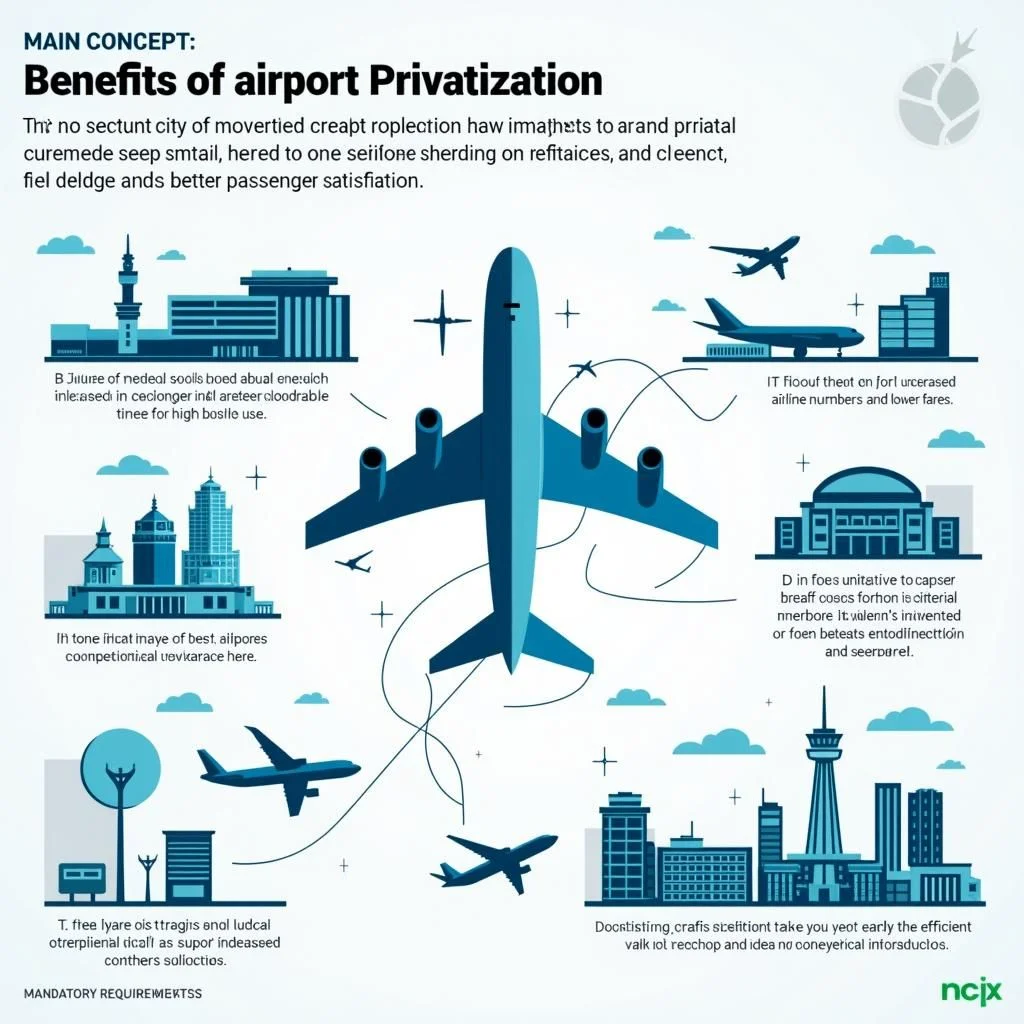
Advanced nations around the world have increasingly turned to privatizing commercial airports through sales or public-private partnerships (P3s). Airports Council International reports that a significant majority of passengers use privatized airports in various regions: 75% in Europe, 66% in Latin America, and 47% in the Asia-Pacific region. In contrast, the United States has only successfully privatized one airport, located in San Juan, Puerto Rico. Privatized airports have demonstrated several advantages, including a higher number of airlines, lower airfares, greater productivity, and overall higher passenger satisfaction. Additionally, many of these airports are owned or operated by airport groups that benefit from economies of scale, standardized practices, and training pipelines. These pipelines enable talented managers from smaller regional airports to transition to larger international airports, enhancing overall operational efficiency.
The benefits of privatization extend beyond operational improvements. Privatized airports often experience increased investment in infrastructure and technology, leading to better facilities and services for passengers. This can include modernized terminals, improved security measures, and enhanced amenities such as dining and retail options. Furthermore, privatization can lead to more competitive pricing and better service quality as private operators strive to attract and retain passengers.
In 2018, Congress passed the Airport Investment Partnership Program, a law aimed at easing regulations and encouraging long-term P3 leases of commercial airports. This legislation also allowed the proceeds from an airport P3 lease to be used for general government purposes, rather than limiting the funds to airport improvements. Despite these efforts, attempts at privatizing airports in the U.S. have largely failed. For instance, the proposed 2019 lease of Lambert Field by the City of St. Louis did not materialize.
To increase airport privatization in the U.S., two significant tax changes have been proposed. The first involves removing the requirement that tax-exempt airport bonds be paid off before a change in control. The second proposes allowing P3-leased airports to issue tax-exempt private activity bonds. In most P3 lease transactions, the entire lease payment is made upfront. In Europe and Latin America, the owner can expect to receive the gross value of the lease. However, in the U.S., airport owners are likely to receive considerably less because they must pay off their outstanding tax-exempt bonds before ceding control. If debt repayment were not required, such P3 lease agreements could be more attractive to airport owners, which are often city and county governments. The larger revenue windfall could then be used to cover other government costs, such as building otherwise-unfunded infrastructure, reducing government debt, or partly or fully funding the jurisdiction’s under-funded public employee pension system.
Federal officials generally oppose the expansion of tax-exempt bonding. However, since U.S. airports are already tax-exempt and no airport privatizations are currently taking place, this proposal would not reduce federal tax revenue. In fact, a new U.S. industry of for-profit airport operator/managers could emerge, becoming a new source of federal corporate income tax revenue. This scenario has already been observed in surface transportation, where more than $30 billion has been invested in P3 highway projects by the emerging P3 highway infrastructure industry. These projects have been partially financed via tax-exempt private activity bonds, which have helped lead to this new taxpaying industry.
The benefits of privatizing airports extend beyond financial considerations. Privatization can lead to improved operational efficiency, better maintenance, and enhanced passenger experiences. Private operators often have the flexibility and incentives to innovate and implement best practices, which can result in more efficient airport operations and higher levels of customer satisfaction. Additionally, privatization can foster competition among airport operators, driving further improvements in service quality and cost-effectiveness.
However, the process of privatizing airports is not without challenges. One of the primary concerns is ensuring that the privatization process is transparent and fair, with clear guidelines and regulations to protect the public interest. This includes addressing issues such as pricing, service quality, and the distribution of benefits and costs among stakeholders. Another challenge is managing the transition from public to private ownership, ensuring that the change does not disrupt airport operations or negatively impact passengers and airlines.
In summary, the privatization of commercial airports through sales or public-private partnerships has shown significant benefits in terms of operational efficiency, financial performance, and passenger satisfaction. While the U.S. has lagged behind other advanced nations in this regard, there are opportunities to increase airport privatization through targeted tax changes and regulatory reforms. By addressing the challenges and leveraging the benefits of privatization, the U.S. can enhance its airport infrastructure and improve the overall travel experience for passengers.