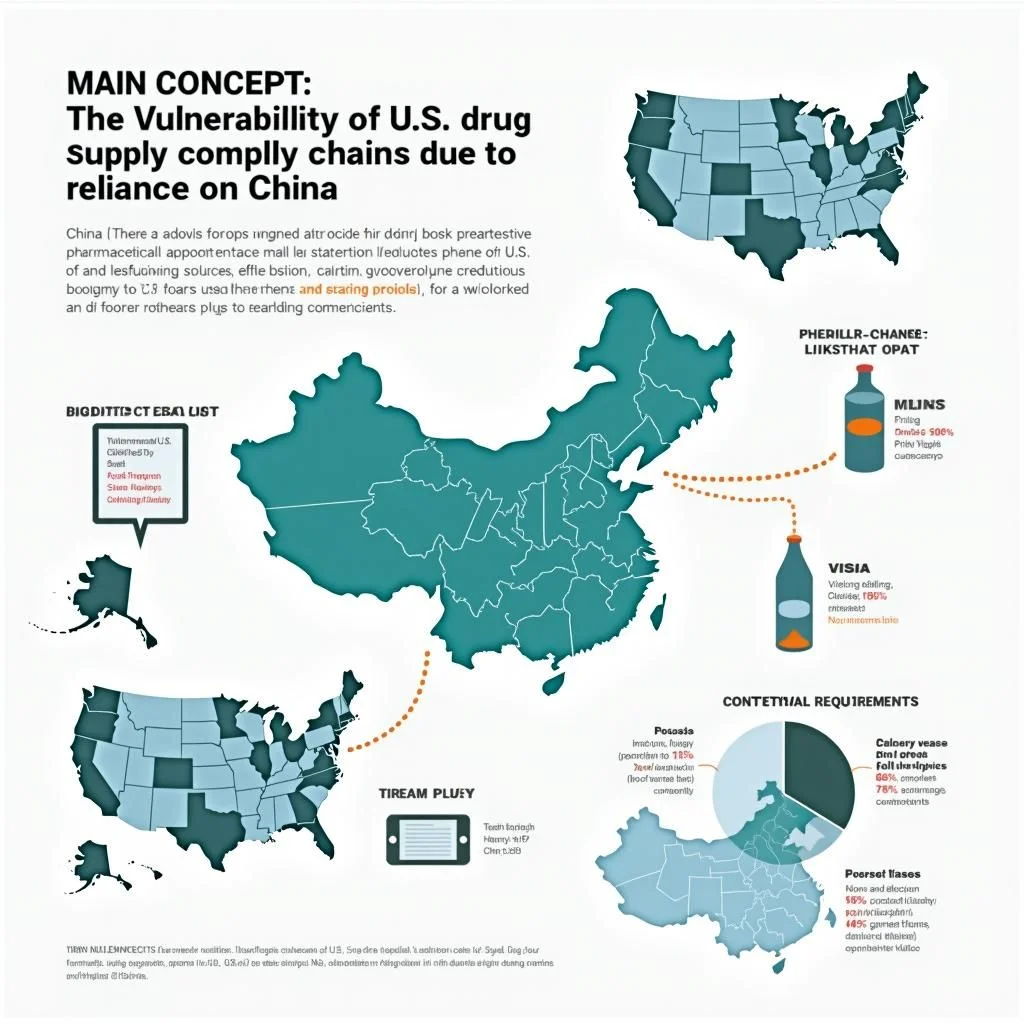
Drug shortages pose a significant threat to public health and national security, particularly in the context of geopolitical conflicts. These shortages arise from various factors, including supply chain disruptions and demand increases. The U.S. drug supply chains are heavily reliant on China, making them particularly vulnerable to geopolitical risks. Understanding the dynamics of drug shortages and the role of China in the supply chain is crucial for developing effective policies to mitigate these risks.
How and Why Drug Shortages Arise
Drug shortages occur when the supply chain cannot quickly adjust to disruptions or increased demand. The severity of a shortage depends on the magnitude of the supply chain shock and the amount of slack in the system. Examples of system slack include high inventory levels of finished products or inputs, and the existence of spare or backup capacity. Generic drugs are particularly vulnerable to shortages due to economic incentives embedded within the reimbursement framework. These incentives lead manufacturers to prioritize cost over reliability, resulting in lower overhead and minimal slack. This economic dynamic makes supply chains more susceptible to shocks, including natural disasters and geopolitical disruptions.
Manufacturing quality issues, often stemming from inadequate FDA oversight and economic pressures, are a common cause of shortages. Permanent product discontinuations and offshoring to geopolitically volatile regions can also trigger shortages. The reliance on China for low-cost inputs further exacerbates these vulnerabilities. While no drug shortages in the last 20 years have been directly caused by export restrictions, the COVID-19 pandemic highlighted the potential for geopolitical disruptions to affect a broader range of drugs.
China’s Role in U.S. Drug Supply Chains
China plays a critical role in the U.S. prescription drug supply chains, particularly in the upstream stages of production. Most small molecule drugs are chemically synthesized, starting with key starting materials (KSMs) transformed into intermediates using multiple reagents and solvents. Some drugs begin with organic processes like fermentation. The API is then combined with excipients to produce the final dosage form (FDF) sold to hospitals and pharmacies.
The common narrative is that the U.S. relies heavily on Chinese APIs. However, the more accurate picture is that reliance is greater for upstream inputs, including KSMs, reagents, solvents, and critical intermediates. China controls the production of many critical intermediates, including those for antibiotics and statins. While some drugs have APIs fully or primarily sourced from China, in aggregate, no more than a quarter of drug units sold in the U.S. have APIs fully manufactured in China.
Chinese firms maintain a strong cost advantage in upstream and increasingly downstream drug supply chains due to lower labor, energy, and transportation costs. The Chinese government has an explicit strategy to expand its position in global pharmaceutical supply chains, particularly in KSM production, driven by economic and national leverage goals. Government subsidies, including tax breaks, subsidized loans, and infrastructure investment, further reduce expenses. Historically, a lax regulatory framework allowed Chinese producers to operate with higher environmental and workplace risks, enabling their cost advantage. More recently, China has begun raising standards and investing in safer, more sustainable manufacturing with ongoing government support.
Prioritizing Which Supply Chains to Support
Securing a drug supply chain requires identifying and securing all weak links, not just some. Given the Chinese cost advantage and the limited funding available, prioritization is essential. The idea of prioritizing drug supply chains is not new; the Trump administration directed the FDA to develop a list of essential medicines. The Agency for Strategic Preparedness and Response (ASPR) narrowed down the list to 86 medicines critical to acute care hospitals and further reduced it to 26 drugs for API stockpiling.
Identifying top targets is key, but so is a broader strategy that includes revisiting which drugs are critical, their reach, and their vulnerability to disruption. A true vulnerability assessment should trace all inputs and steps, from KSMs to finished drugs, and consider geopolitical risks and other prominent shortage risks. The assessment should also be relative, considering the capacity of other nations. ASPR should consider moving away from a fixed list of essential drugs and instead rank a broader set of drugs by criticality and reach, followed by comprehensive vulnerability assessments.
Shifting Demand Away from Chinese Chemicals
Current policy proposals, such as tariffs, payment incentives, or Made-in-America mandates, target the making of final drug formulations and late API synthesis steps. However, these proposals will do little to de-risk U.S. drug supply chains from reliance on China unless they also address upstream reliance on Chinese KSMs, reagents, solvents, intermediates, and inactive ingredients.
Given China’s cost advantage and U.S. budgetary constraints, policymakers must prioritize which supply chains to de-risk. They must also consider the alternative supply chains and ensure sustained market demand for those alternatives. Few in the industry would argue that there are readily available alternatives to all Chinese inputs, and even fewer that are priced competitively. The lack of alternatives goes beyond inputs made in the U.S.; many other countries have also ceded to Chinese firms the supply of low-margin chemicals.
Standing Up Alternate Supply Chains
To address the unfavorable economics for fine chemicals infrastructure, the U.S. should consider funding chemical industrial parks to make ingredients for prioritized drugs. Such parks are used in Europe, India, and some U.S. states, either with direct government support or a regulatory framework that encourages them. The parks share infrastructure for industrial wastewater treatment, utilities, and product testing, all of which lower overhead, improve logistics, and help meet regulatory standards. Such parks also protect government investment by allowing new companies to step in if others fail.
For some APIs, synthetic biology may offer a viable alternative. Synthetic biology is a technology where APIs are engineered in living cells, akin to how biologic drugs are made. However, the technology may only work for some APIs, and there are important cost considerations. In non-crisis times, the marginal cost of production will likely be higher than through traditional means, creating questions around sustainability. In crisis times, the heavily patented nature of the technology may become fiscally challenging.
Leveraging International Cooperation
Given the expenditures required, especially when coupled with market reforms, it is necessary to think about ways to de-risk from China indirectly, including leveraging international cooperation and partnerships from non-adversarial nations. Statins, widely prescribed for cholesterol, are a great example of drugs where indirect engagement makes sense. Statins are not on any of the U.S. government essential medicine lists, but with perhaps as many as 90 million Americans taking them, a major shortage would become a significant disruption to care for many, likely with political repercussions. The Indian government is acutely aware of its manufacturers ceding a specific statin intermediate step to China, so it has added atorvastatin to the list of drugs for which it will subsidize China de-risking efforts. This subsidy indirectly benefits American patients, so U.S. policymakers would be wise to support such initiatives.
Sustaining Demand for Alternative Supply Chains
Alternative supply chains will only succeed if there is sufficient demand to sustain them. Sustaining demand for more expensive inputs will require counteracting some of the principal forces that have made generic drugs a resounding healthcare cost control success. By emphasizing price competition, the current system undervalues supply chain reliability. Generic manufacturers face price pressure from a consolidated buyer base, and unless Congress acts, some generic drugs, including those made domestically, will continue to be limited in their ability to pass on legitimate cost increases.
Many of the drugs on the ASPR list of 86 are at high risk of shortage, and because most are generic sterile injectables sold in hospitals and clinics, policy solutions can leverage the Medicare program to shift purchasing decisions from an emphasis on lowest price toward reliability of supply. The Senate Finance Committee has put forward a bipartisan proposal of add-on payments for purchasing from more reliable sources, as a way to lower the risk that the drug goes into shortage. Further work needs to be done to refine and advance what is likely the most consequential market reform proposal to address drug shortages.
The inability to pass on legitimate price increases is another stumbling block for many supply chain resilience reforms, including the Senate Finance add-on payment proposal. Currently, generic drugs used by Medicaid patients face an inflation cap equal to the rate of inflation, and the same cap then extends to the outpatient hospital settings through the 340B program, for which most hospitals qualify. Some clinically important drugs, such as chemotherapy agents, have large exposure to such caps. But such caps limit the ability of manufacturers to pass on cost increases from sourcing inputs outside of China.
Addressing the competition dynamics for finished-dose drugs is essential, but it must be paired with reforms that counter the persistent incentive to source cheap ingredients. The way to achieve this is to tie government support for APIs or FDFs to a requirement that inputs be sourced outside China. A word of caution here about Made-in-America mandates. The current environment does not support full supply chain Made-in-America mandates, given the lack of U.S. alternatives for many inputs. A move limited in scope to the military only, if given enough of a runway, could work because it would not require broader inflation rebate reforms. But even a narrow focus on military supply chains needs to build in additional quality assurance steps because domestic facilities have not been immune to shortage-causing manufacturing quality problems.