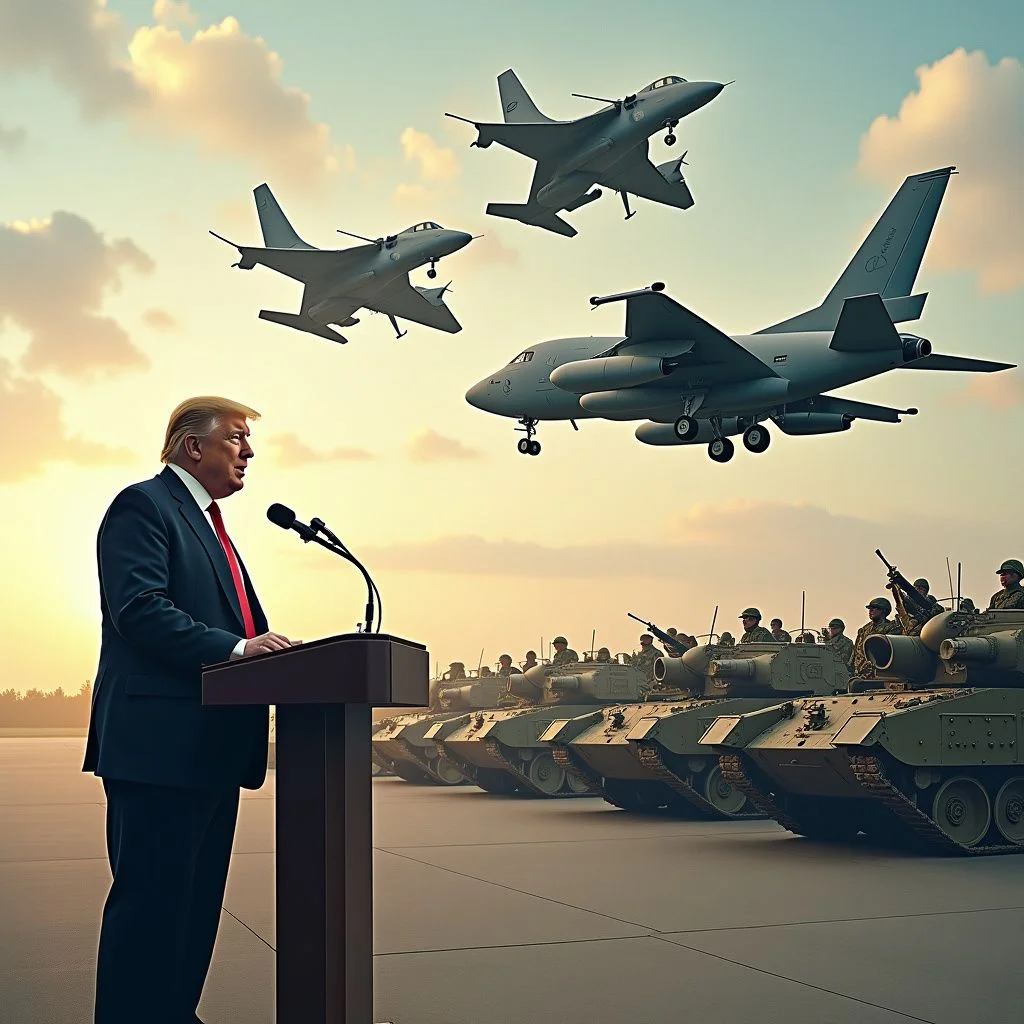
Donald Trump delivers a speech to the troops at Selfridge Air National Guard Base in Michigan on April 25, 2025. In his recent National Security Strategy (NSS), Trump repeatedly emphasizes the idea that military force is essential for security. This stance is not new; many leaders throughout history have believed that the greater their military power, the greater their security. Trump, however, takes this idea to an extreme by declaring his intention to have “the most powerful and capable army in the world” as a fundamental instrument to safeguard his own interests.
The year 2025 ends with the expectation that the Senate will approve what the House of Representatives already approved on December 10: over $900 billion for the defense chapter in the next fiscal year. This figure reflects the priority Trump gives to military defense, a strategy that many consider an attempt to preserve a status quo from which the United States has been the main beneficiary for decades.
The United States self-proclaims as the guarantor of world peace, acting as a kind of global police due to the lack of an effective United Nations (UN). However, this “Pax Americana” implies a model of relations designed to consolidate the position of the United States as a planetary hegemonic power. The assertion that “the days when the United States alone sustained the world order as Atlas have passed” sounds grandiose and cynical, given that the United States continues to try to maintain its hegemony.
Any actor that does not adapt to the role assigned to it by the United States in the game’s script is immediately identified as an enemy of peace. It is evident that all states on the planet have legitimate security interests and must have a tool for deterrence and punishment, that is, Armed Forces. However, it is not enough with the “strong power” to guarantee one’s own security. Trump’s militaristic bet, by despising the “soft power,” supposes a huge mistake.
The “soft power” includes components such as commercial, cultural, diplomatic, and donor, which serve to attract and align others in favor of those who know how to exercise it. It reduces the level of confrontation and gains allies to face others. Decisions such as launching a trade war or eliminating the United States Agency for International Development (USAID) will not only cost many human lives but also represent a notable loss of American influence in many parts of the planet.
Furthermore, even counting on the best troops and defense equipment imaginable, it is impossible to guarantee invulnerability to many of the hybrid, conventional, and nuclear threats that define our world today. Decisions such as the deployment of a new missile shield, the Golden Dome, not only do not guarantee protection against increasingly intrusive arms but also stimulate the proliferation of new nuclear artifacts, as Russia has confirmed.
There are threats and risks, such as the climate crisis, international terrorism, and organized crime, that are not of a military nature and that, therefore, cannot be neutralized by deploying many combat means. Finally, the mistake is multiplied if one chooses to put the European Union (EU) in the crosshairs as a target to be beaten. The United States does not have on the planet a partner with whom it shares more values, principles, and interests than with the Twenty-Seven. In a scenario in which its power wanes and its hegemony is at stake before the push of China, it would seem elementary to decide to reinforce the ties that unite both shores of the Atlantic even more.
However, the messages that Trump and his delegates send to their European allies cannot be more hostile, if not directly hostile. The worst is not only that the United States is entrenched in the error, but that the Twenty-Seven try to imitate it, with a rearmament plan that will further strain the social cohesion of their populations, weakening the welfare state, and which is fundamentally based on nationalist considerations.