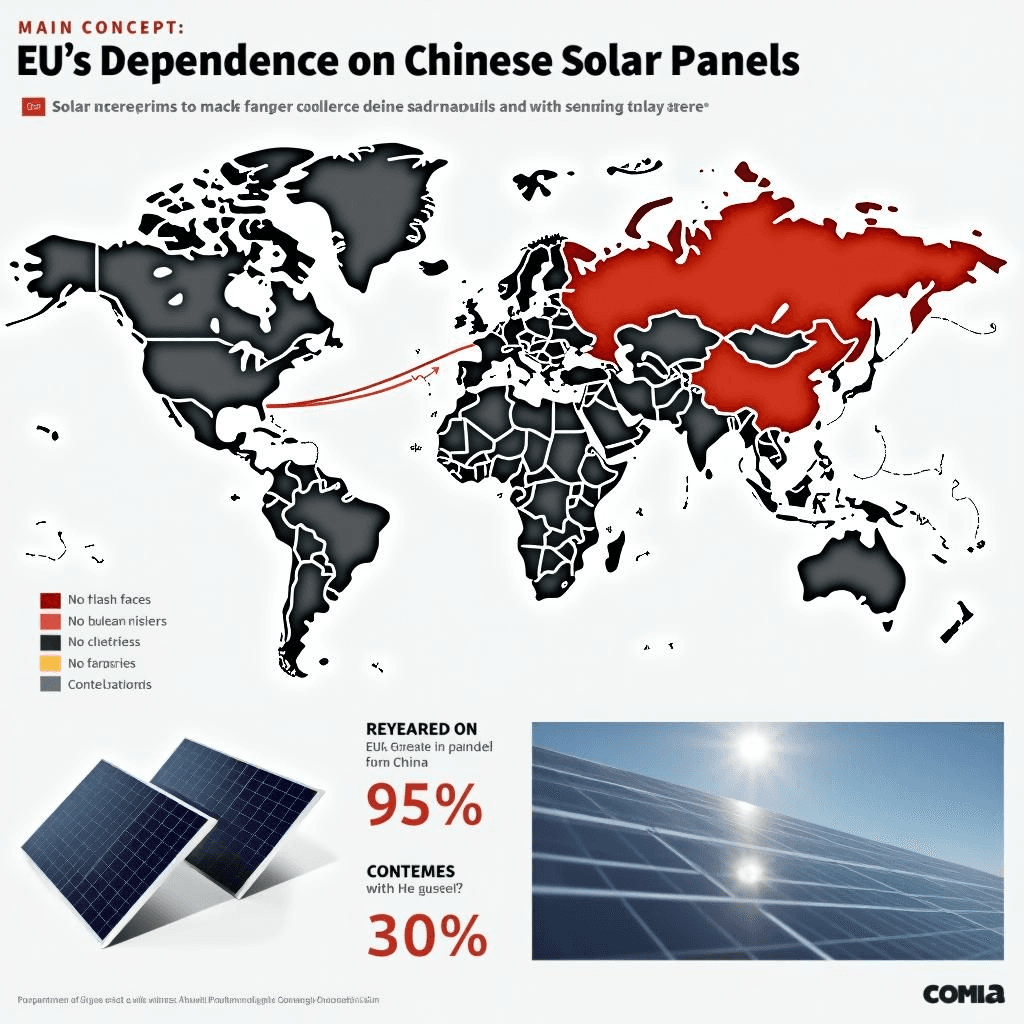
The European Union plans a significant increase in photovoltaic (PV) solar panel capacity, from the current 263 GW to nearly 600 GW by 2030. Without changes, this expansion will be based almost exclusively on solar panels imported from China, which supplies more than 95 percent of the solar panels used in the EU. This dependence has raised concerns about the EU’s economic security and geopolitical vulnerabilities, especially in light of recent global disruptions.
The EU has agreed in principle to a non-binding threshold of 40 percent self-sufficiency for solar panels and other identified strategic technologies, to be achieved or exceeded by 2030. However, in the specific case of the solar sector, there is no strong economic justification for an import substitution strategy.
This strategy could increase the cost of solar panels, slow down deployment, and create industries excessively dependent on subsidies. Subsidies for solar manufacturing in the EU are not appropriate based solely on European production criteria. Subsidies could be justified in terms of innovation, supporting new solar products that have a genuine opportunity to develop into sustainable industries that contribute to climate goals.
To address short-term concerns about dependence, alternative tools such as accelerated deployment of solar energy, strategic storage, and gradual diversification of import sources should be employed. In the long term, the recycling of solar panels deserves greater attention and funding.
In terms of strengthening economic resilience in relation to China, Europe must implement an industrial policy that intervenes in sectors more likely to contribute to sustainable economic growth and alleviate bottlenecks in decarbonization.
Solar energy promises to be a key driver of Europe’s energy transition. By 2030, EU countries aim to reach nearly 600 gigawatts of installed solar PV capacity, as set out in the EU Solar Energy Strategy. If this target is met, solar PV will become the largest source of electricity production in the EU in terms of capacity.
Additionally, the rate of solar deployment will be faster than that of any other energy source; for example, plans to increase wind capacity aim to reach around 500 GW by 2030, compared to the current 200 GW.
This solar revolution in Europe is, and will continue to be, predominantly ‘made in China’. In 2022, more than 95 percent of Europe’s solar panels came from China, which has established itself as the global hub for PV solar panel manufacturing.
Chinese solar panels are becoming cheaper and more innovative, which is good news for the EU as it allows for the acceleration of solar energy deployment in a cost-effective manner. However, such high dependence on a single supplier could expose the EU to economic risks related to high market concentration and potentially to geopolitical risks related to the eventual use of this dominant position.
Supply chain disruptions related to the pandemic, the energy crisis, China’s growing authoritarianism in controlling exports of critical raw materials, and competitive pressures arising from the U.S. Inflation Reduction Act have concerned and continue to concern European policymakers.
This has led to a renewed debate on how to define and pursue economic security and, more specifically, to a resurgence of new industrial policy initiatives aimed at fostering the EU’s competitiveness and geopolitical resilience in clean technologies and critical raw materials.
In February 2024, EU institutions agreed in principle to the Net Zero Industry Act (NZIA), with the aim of supporting domestic manufacturing of clean technologies, such as PV solar panels, as strategic projects.
Part of the NZIA is a plan to ensure that the manufacturing of strategic net-zero technologies in the EU “approaches or reaches” a benchmark value of 40 percent of the implementation needed in the EU. This approach could rely heavily on import substitution. This is controversial because it ignores the costs of promoting self-sufficiency compared to using cheaper imports and, more broadly, because it suggests a shift towards protectionism.
Additionally, adopting a flat benchmark for different technologies in which Europe has very different starting positions and growth potentials is not economically rational.
The PV Solar Manufacturing Policy specifically evaluates the case of PV solar panel manufacturing.
It begins by describing the characteristics of PV solar panel supply chains and then outlines the historically and currently divergent trajectories of Europe and China in PV solar panel manufacturing.
It evaluates the economic case for European intervention to stimulate domestic manufacturing, finding that there are no clear benefits of decarbonization or economic growth in doing so, leaving the mitigation of the risk of excessive dependence on Chinese imports as the only justification.
Even this risk should not be overstated.
Innovation, and not domestic content, should be the defining criterion for manufacturing subsidies.
### Understanding PV Solar Panel Supply Chains Any industrial policy strategy in the solar sector must be based on an understanding of the complexities of the PV solar panel supply chains. The solar industry encompasses so many manufacturing processes that the concept of ‘public support for PV solar panel manufacturing’ is a simplification.
The production of a solar panel begins with quartz (SiO2), commonly found in sand. This is transformed into polysilicon through an energy-intensive process of fusion and purification. Polysilicon is used for the production of solar panels, semiconductors, and electronic devices. China represents approximately 80 percent of the global polysilicon production capacity.
Around 35% of the global polysilicon production capacity is located in Xinjiang, a Chinese region under international scrutiny for human rights violations and forced labor involving Uighurs and other predominantly Muslim groups. The production of polysilicon is a crucial step in the PV solar panel supply chain.
China has dominated this market, allowing for massive and economical production of solar panels. However, this dependence on a single supplier can create geopolitical and economic vulnerabilities.
The EU must consider the implications of its dependence on the PV solar panel supply chain.
Diversifying import sources and developing alternative technologies are essential to mitigate these risks.
Additionally, innovation in PV solar panel manufacturing is crucial to maintain competitiveness and reduce dependence on imports.
The EU must invest in research and development to foster innovation in this sector, which could include the development of new materials and more sustainable manufacturing technologies.
Europe’s energy transition to solar power is a crucial step to achieve its climate goals and reduce dependence on fossil fuels.
However, the EU’s current dependence on China for PV solar panel imports poses significant risks that need to be addressed.
Diversifying import sources, developing alternative technologies, and investing in innovation are essential to mitigate these risks and ensure a sustainable and secure energy transition.
The EU must adopt a comprehensive strategy that addresses these concerns and promotes sustainable economic growth and geopolitical resilience in the solar energy sector.
Recommendations for the EU
To address these risks, the EU should consider the following recommendations:
- Diversify import sources for PV solar panels
- Develop alternative technologies for solar power
- Invest in research and development to foster innovation in PV solar panel manufacturing
- Promote sustainable economic growth and geopolitical resilience in the solar energy sector
By implementing these recommendations, the EU can ensure a sustainable and secure energy transition while promoting human rights and ethical business practices in the solar energy sector.
Conclusion
In conclusion, the EU’s dependence on China for PV solar panel imports poses significant risks that need to be addressed. By diversifying import sources, developing alternative technologies, investing in innovation, and promoting sustainable economic growth and geopolitical resilience in the solar energy sector, the EU can ensure a sustainable and secure energy transition while promoting human rights and ethical business practices.