The advance of anti-government rebels towards Homs, the third largest city in the country and a crucial strategic point, continues. Foci of rebellion have been registered both to the south and east, and Damascus is the next objective. Palestinians in Gaza desire victory for the Syrian people, and Syrians call for a free Palestine. On social networks, videos and images multiply showing how the recent and surprising developments in Syria are only part of the broader conflict already underway in the Middle East.
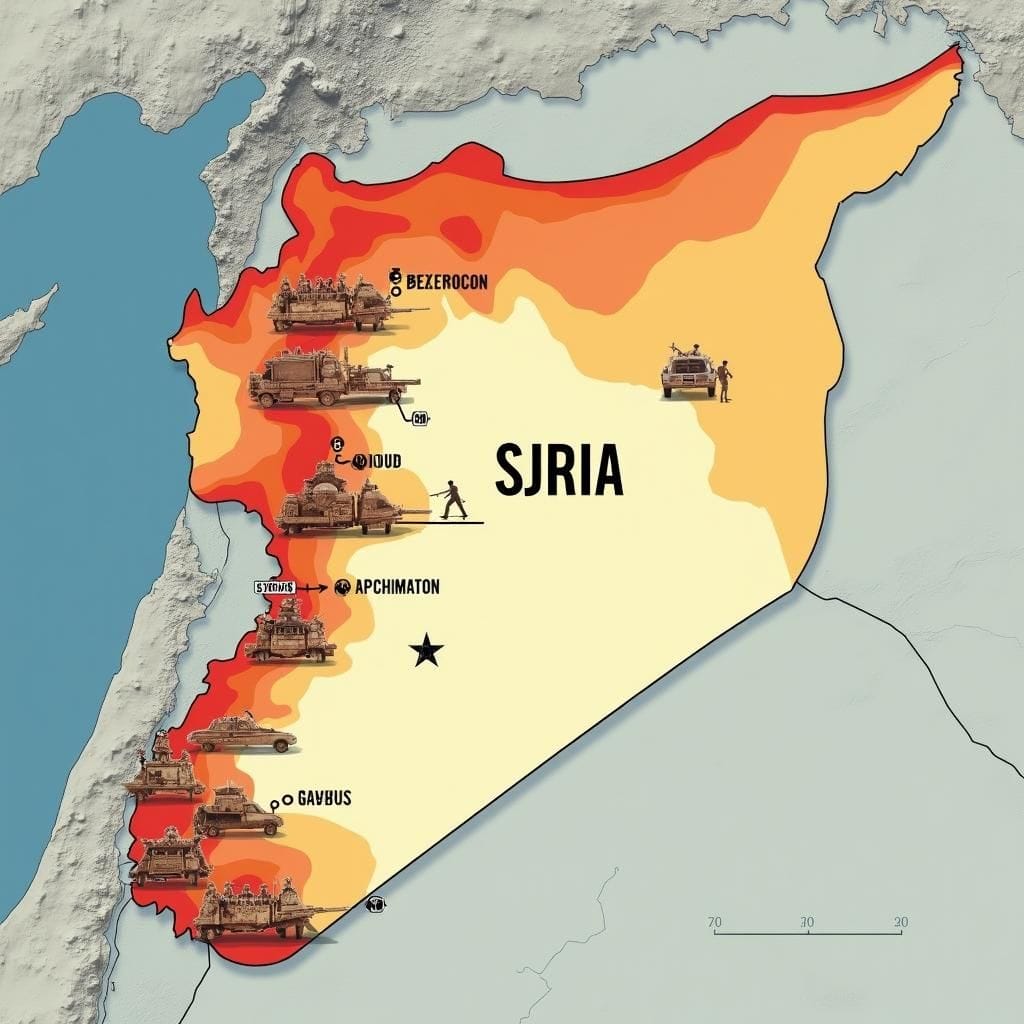
After taking Aleppo and Hama, respectively the second and fourth largest cities in the country, anti-government rebels led by Hayat Tahrir As-Sham (HTS) are rapidly advancing towards Homs, a strategic enclave for access to the coast and stronghold of the Alawite minority of President Bashar Al-Assad. According to the Syrian Observatory for Human Rights, armed militias are five kilometers from the city perimeter, after taking control of Rastan and Talbisseh, between Hama and Homs, indicating “the total absence of regime forces” in those areas. Although it is not possible to verify these reports independently, they are supported by news of thousands of people fleeing the city since the previous night and throughout the night.
Control of Homs will also influence the future of the war in neighboring Lebanon, as rebels seek to close Hezbollah supply routes. Significantly, in the last few hours, Israel has resumed bombing border crossings between Lebanon and Syria, shortly after their reopening, further violating the fragile ceasefire agreement signed last week. Clashes have also been reported south of Damascus, especially in Daraa, the cradle of the revolt against Assad’s regime in 2011, where armed men would have attacked several checkpoints. Various sources report that government forces have withdrawn from their positions in Deir Ezzor, while in the Druze provinces of Suweida and Quneitra, desertions within the army ranks are increasing.
In a long and exclusive interview with CNN, Abu Mohammed Al-Jolani, leader of the main group leading the armed opposition in Syria, HTS, explained the objectives of the offensive: “Our ultimate goal is to overthrow the regime of President Bashar Al-Assad.” In his first interview in years, from a secret location in Syria, Al-Jolani spoke about plans to establish a government based on institutions and an “elected council.” “When we talk about objectives, the revolution’s goal remains to overthrow this regime. It is our right to use all available means to achieve this objective,” he stated, adding that “the seeds of the regime’s defeat have always been within it… the Iranians have tried to revitalize the regime, gaining time, and then the Russians also tried to sustain it. But the truth is: this regime is dead.”
During the interview, Al-Jolani, who used his real name, Ahmed al Sharaa, instead of his nom de guerre, projected the image of a pragmatic leader open to dialogue, in stark contrast to the image of Al Qaeda leaders, to which the group was affiliated until 2017 when it was called Jabhat al Nusra.
Turkish President Recep Tayyip Erdogan also made an unprecedented statement about events in Syria: “After Idlib, Hama, and Homs, obviously the target will be Damascus. The march of opposition forces continues. We hope that this advance in Syria continues without incidents or problems,” Erdogan said, speaking to journalists after participating in Friday prayer at the Hazrat Ali Mosque in Istanbul. “We have called Bashar Al-Assad, we have told him: go ahead, let’s determine the future of Syria together. Unfortunately, we have not received a positive response.” The president’s words seem to dispel any doubt about Ankara’s position and commitment to supporting the anti-government advance, which, with its rapid march towards the capital and the absence of a strong counteroffensive by Syrian troops, represents the greatest threat to the Damascus regime in a decade.
Since the start of the Syrian conflict in 2011, Ankara has called on Assad to engage with the Syrian people to find a “political solution.” As reports from the ground continue, confirming the rapid advance of anti-government militias, there are also movements on the diplomatic front. The foreign ministers of Turkey, Iran, and Russia will meet on Saturday in Doha to discuss the situation in Syria, according to a Turkish diplomatic source. The three countries have regularly held conversations about the country’s future since 2017, in a trilateral format as part of the Astana Process. According to several observers, it is probably the last opportunity to avoid a collapse of the Syrian regime, but only if Assad is willing to make political concessions. If he does not, he will hardly be able to count on the support of his main sponsors.
The lack of support from his allies, along with economic frustration and the lack of preparation of his army, has caused the dramatic withdrawal of the Syrian Arab Army (SAA) from all positions previously conquered by the rebels. Without a political agreement, the fall of Homs could open the way to Damascus, making events precipitate quickly. The current situation shows that Vladimir Putin believed he had achieved his objectives in Syria. Unable to normalize the entire country under the domination of the Assad family, the Russians settled for liberating from militias the “counting Syria”: the capital, the most important cities, and the coast, where the Russian fleet regained access to the Mediterranean. Then, from the desert and the neighborhoods of cities devastated by bombings a decade ago, Hayat Tahrir al-Sham reappeared. At that time, it was not one of the most important militias; now it threatens Damascus.