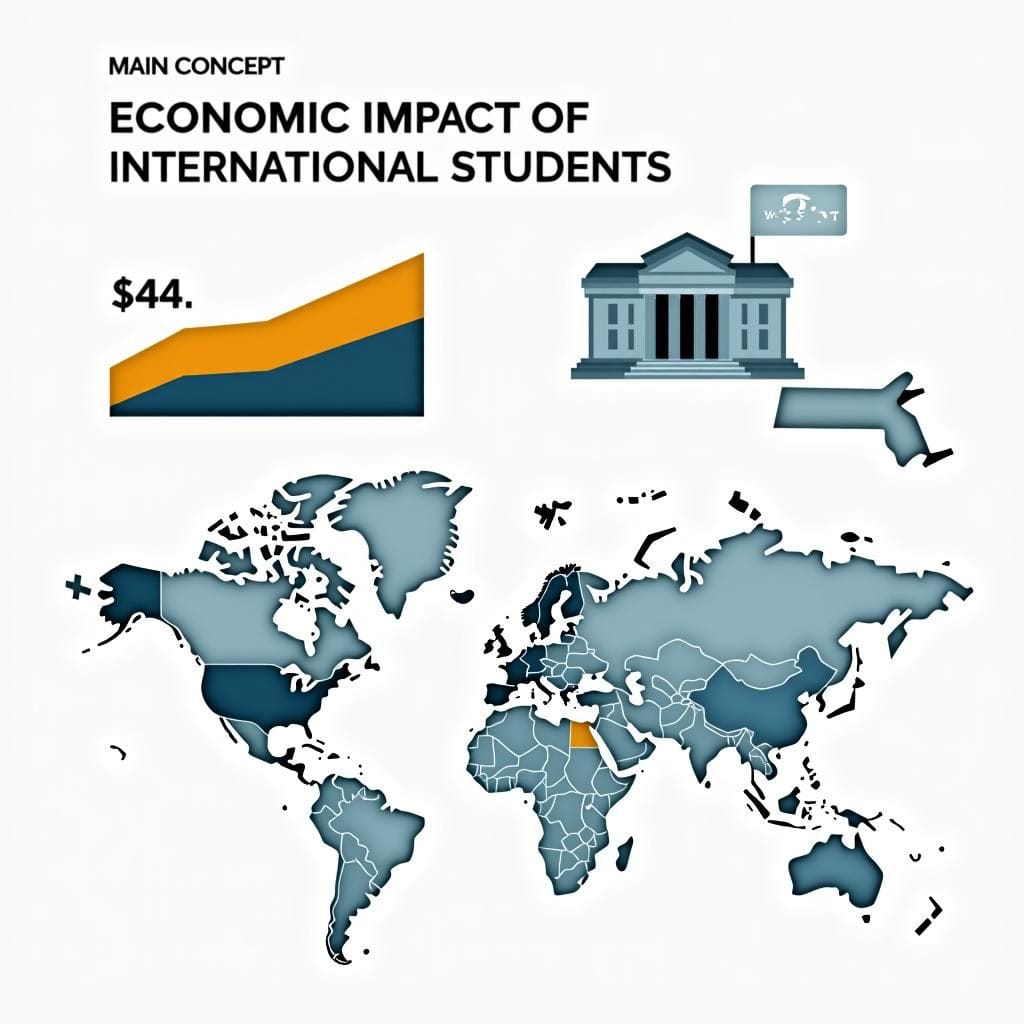
Ongoing clashes between the Trump administration and elite universities threaten to discourage or even outright bar international students from coming to the U.S. to further their schooling. This could cost around $44 billion, add much to the trade deficit, harm many college budgets, and badly damage businesses in many college towns.
A key question arises: where would the damage strike most heavily? Would just a few parts of the country be at great risk, or would the damage be spread relatively evenly? Would just a few colleges see massive enrollment hits, or would enrollment hits be spread widely?
Based on an analysis of national data on the topic, it is concluded that a handful of blue states would see large drops in spending by international students. Beyond these states, the drop is spread roughly evenly across the country. Relatively few colleges would lose a large share of their undergraduate enrollment, but those at the highest risk are heavily concentrated among private rather than public colleges. Most of the more vulnerable colleges are not very large and have a special focus, such as art, music, or business. Additionally, colleges affiliated with Christian churches would be disproportionately affected.
Which States Would Be Hit Hardest?
Before examining the somewhat messy answer, it is important to note that the impact on states depends on various factors. We do not yet know whether the number of international college students will decline significantly or, if it does, how soon that might happen. At the moment, getting a student visa has become difficult. Consular interviews to apply for new or renewed student visas were completely frozen and have just recently been reopened with new conditions. Early data suggests a large drop in the number of student visas processed this May. Will the student visa restrictions be lifted in time for incoming freshmen to arrive this fall? We do not know. And the majority of next year’s students are already here as returning students—they do not need a new visa to continue their studies. Even if the visa door remains shut, it will probably take several years for the full impact to be felt.
Reports highlighting the states and schools with the largest international student populations provide some insights, but they do not fully address vulnerability. For example, California has the most international college students. While factually true, California also has the most college students (regardless of nationality) and the most people. Whether looking at states or at individual schools, it is far better to compare international students to the overall size of the state or school.
A straightforward way to understand the impact is through the estimated economic contribution of international college students, which averages about $130 per U.S. resident. For a typical family of four, that’s just over $500 a year in potentially lost spending. This is a little more than the value of U.S. coal production and about a fifth of the value of U.S. oil and gas production. However, this average assumes the contribution is spread evenly across the population, when in reality, international students are concentrated in college towns and campus communities.
Factoring in the location of international students, the economic impact bites unevenly across the country. Mostly, but a few places would be hit noticeably higher—and, yes, those most vulnerable to international student declines are blue states. The following picture weights the contribution of international students in each state divided by the state’s population based on NAFSA data. The states are categorized and color-coded based on the value of their economic contribution relative to the national average of $130 per person: less than $65 (below 50% of the average); $65 to $130 (50% to 100%); $130 to $195 (100% to 150%); and more than $195 (above 150%).
Most of the country falls into the two lowest categories. About three-quarters of the states would see impacts at or below the national average. For example, the estimated impact in Arizona is $121 per inhabitant, while in Hawaii the impact is $87 per person. Massachusetts is a standout, high-impact state with an estimated $554 per-person impact. What’s harder to see visually is that area-wise, tiny Washington, D.C., will see far and away the largest impact; there, the NAFSA estimate comes to $855 per person. New York ($319), Rhode Island ($254), and Connecticut ($218) are the only other states where the estimated impact is over $195 per state resident. While California hosts the largest number of international students, its estimated economic impact is $164 per resident—somewhat above the unweighted national average of $130, but not dramatically so. It’s comparable to the impact in more politically moderate states like Michigan ($151) and Pennsylvania ($170).
Which Colleges Are Most at Risk?
TEXTO FORMATEADO PARA WORDPRESS:
Identifying which colleges are at risk of large enrollment drops and the associated financial losses involves understanding the complexities of international college student demographics. Overall, a bit over 80% of “college students” are undergraduates, and the rest are engaged in graduate studies. The distribution is very different for international students, where only about 38% are undergraduates.
Another complication is that international undergraduates, master’s students, and law and medical students are usually revenue sources for universities by paying tuition. Research doctoral (Ph.D.) students often are not, as they typically assist with teaching and research in exchange for tuition and living support from the university. To further complicate matters, some master’s students are actually just “entry level” Ph.D. students—and therefore may not be paying tuition—while other master’s students are seeking professional, terminal degrees and usually are paying tuition.
Federal IPEDS data does not do a great job at identifying which students are contributing tuition payments. Absent better data, institutional vulnerability is reported based only on undergraduate enrollment, with the caveat that this leaves out some institutions that rely very heavily on international master’s students. This decision may not make much difference in practice: the comparison between undergraduate international enrollment and overall international enrollment shows that the distribution of institutions is similar, where only a small minority of institutions have more than 10% international students.
The next issue is how much of an enrollment hit would universities have to take to be considered a “big” hit? There is no single answer, of course. Somewhat arbitrarily, schools are split into categories according to whether international students make up 30% or more of undergraduate enrollment, 30% to 20%, 20% to 10%, or under 10%.
The set of schools in the highest—greater than 30%—category is nearly identical whether measured by undergraduate or overall enrollment. In the mid-range vulnerability categories, there are some differences in where schools fall. Very high international undergraduate enrollment schools differ from other schools in several ways.
The first is that high international enrollment schools are overwhelmingly private. In fact, every school in the over 30% and 30% to 20% categories is private. And 87% of schools in the 20% to 10% category are private. In contrast, somewhat less than half of all institutions in the under 10% category are private. However, some public universities still face serious financial threats even if international students comprise a small share of their enrollment because tuition rates for international undergraduates are so much higher than for in-state students.
For example, at one large public university, international students make up about 9% of the undergraduate student body. But because tuition for international undergrads is more than triple the tuition for in-state students, the loss of tuition income from a major downturn in the number of international students would matter a whole lot.
The second characteristic of high international enrollment schools is that they are small. This is especially true of the schools in the highest international enrollment category, where the median enrollment is 271 students. Small schools typically have less financial flexibility than larger schools. Thus, many of the schools with over 30% international undergraduate enrollment may be at special risk.
Note, though, that a handful of schools in this category are larger and are either particularly prestigious or have background support from affiliated organizations that may protect against enrollment declines.
The schools with high international undergraduate enrollment are also disproportionately schools that self-describe as having a special focus, mostly in the arts broadly defined or in business. Whether having a special focus makes a school more or less vulnerable to a loss of international students is not clear.
Possibly the most surprising characteristic of high international enrollment schools is that they are disproportionately Christian schools. Many Christian schools are affiliated with evangelical beliefs, spreading their faith globally.
A sudden loss of 30% of enrollment may well be a disaster for an institution. While only a few schools appear to be at this level of risk, the possibility of much smaller losses is still quite scary. One study suggests that even a partial decline in international students could have serious consequences.
If the U.S. lost 15% of its international student population, a substantial number of colleges could experience at least moderate financial repercussions. In the end, nearly every college enrolling international students has some vulnerability to volatility and uncertainty about the future of international student demand and ease of enrolling in the United States.