Global support for Palestine is on the rise, driven by the humanitarian disaster in Gaza and Israel’s international isolation. However, without a genuine political project and with inert Palestinian leadership, the proclamation of a Palestinian state risks remaining a symbolic act. The situation is complicated by fundamental issues: where exactly this state should arise, whether in the West Bank, where 450,000 Israeli settlers control the lives of 2.7 million Palestinians? What should be its capital, considering that Jews represent 57% of Jerusalem’s inhabitants and 220,000 of them occupy parts of the city considered Arab by international law? Moreover, ignoring Israel’s unilateral annexation of Jerusalem in 1980, when should this state be born?
Israeli government’s strategy
The Israeli government has adopted a strategy aimed at preventing the creation of a Palestinian state. This strategy has been described as a Zionist, security, and national move, with the objective of determining the future of the nation. In May, 22 new Jewish settlements were announced in the occupied territories. This announcement was accompanied by the proposal to create a “humanitarian village” in Gaza, a ghetto where the Netanyahu government intends to confine 600,000 Palestinians, starving them. Additionally, there is the proposal to annex the Gaza Strip, even at the cost of sacrificing Israeli hostages in Hamas’s hands.
This reality confronts the increasingly universal will to recognize the Palestinian state. In favor of a proclamation are four of the five members of the UN Security Council (the United States opposes) and 143 of the 193 member states. However, even the majority of those abstaining or opposing do not oppose recognition; they only believe that doing so now is premature or counterproductive. An example is Italy. A generalized political boycott and further economic sanctions against Israel could have an immediate and concrete effect. However, Western governments seem incapable of implementing such measures, crushed by the weight of history. Although Palestinians bear no responsibility for the Holocaust or anti-Semitism, they are the ones who suffer from it. However, the boycott that governments do not implement is carried out by Western public opinion: universities, professional associations, research centers, canceled sabbaticals, closed vacation spots. Israelis are already under sanctions, isolated from the world to which they feel they belong.
Netanyahu’s government continues the massacre in Gaza, ignoring the price it is paying for its own country as well.
Hamas and Israeli leadership
Hamas and the Israeli premier are similar in their stubbornness to maintain power rather than defend the interests of their fellow citizens. Even Arab League and Islamic community countries have reaffirmed their support for Palestine and imposed on Hamas the surrender to the Ramallah Authority, which, with international help, should govern Gaza. However, Islamic movement terrorists have never cared about governing the strip; they have never done so. They do not intend to give up arms to fight their bloody jihad. Like the nationalist-religious extremists of Netanyahu’s government, who do not stop the war because, according to the newspaper Yedioth Ahronot, the objective is an ethnic cleansing that Hamas extremism justifies and in some way feeds.
Abu Mazen’s leadership
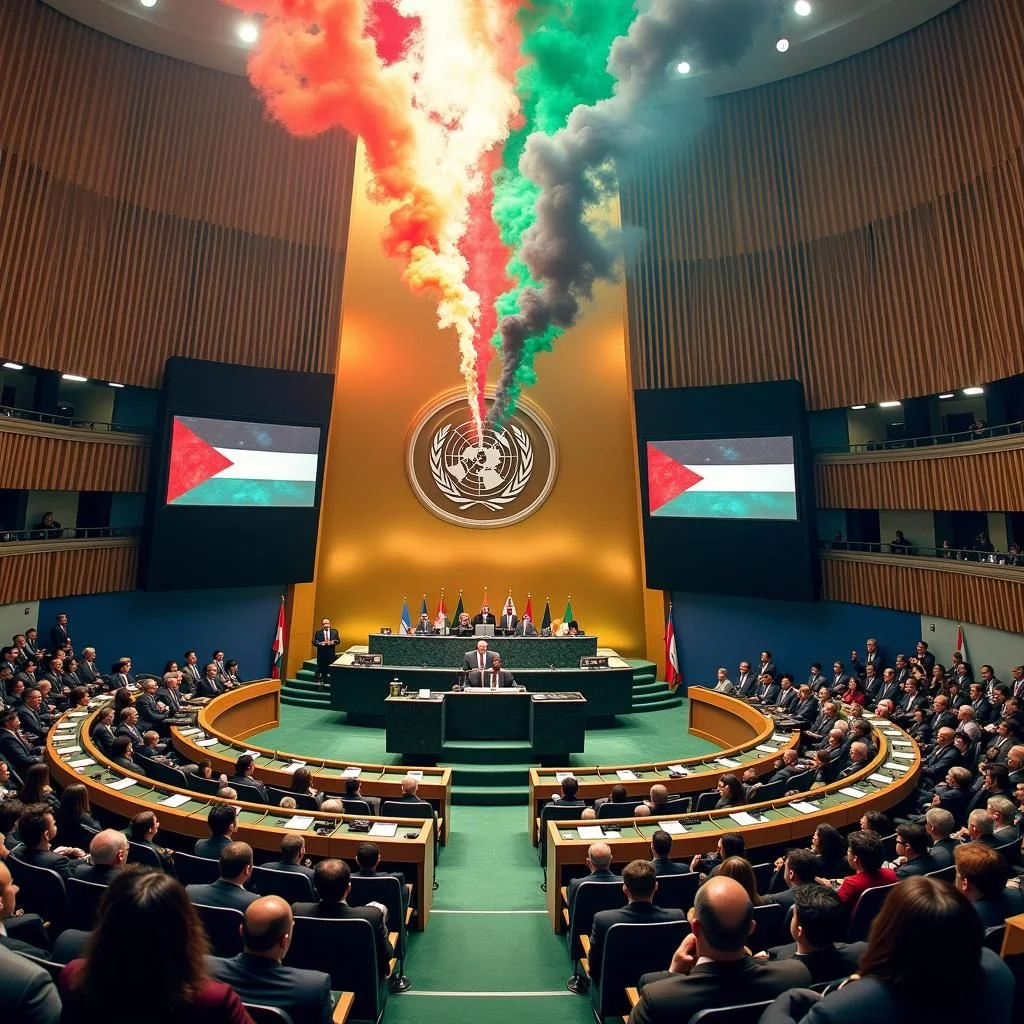
Does it make sense to proclaim a state that cannot be born? And that, in September, at the UN General Assembly, could steal the spotlight from Ukraine? Vladimir Putin and Xi Jinping could be more pro-Palestinian than the Palestinians themselves just to make the European conflict forgotten. Perhaps yes, there is a utility: it will increase Israel’s isolation and its civil society will no longer be able to ignore it; it will give more strength to the growing number of Israelis who begin to protest against a senseless and unsustainable immoral war.
In this worldwide chorus of initiatives in favor of a Palestinian state, the one who should govern that state is missing: the Ramallah Authority. President Mahmud Abbas, also known as Abu Mazen, has never been a fighter but always a bureaucrat. What is happening in the world is a great opportunity for Palestine, perhaps the last if it can materialize. Its leader should visit every capital in the world, meet the world’s powerful to give political substance to the solidarity that is winning the Palestinian cause. However, nothing happens, as if reforming the system, renewing it in men and ideas, were not an urgent imperative. As a condition for its recognition, Canada has explicitly requested these reforms. However, Abbas does not respond: as he did in 2014, when Barack Obama and his Secretary of State John Kerry advanced the last peace proposal without ever receiving a response. Abu Mazen is almost 90 years old. In the world, only Paul Biya of Cameroon, 97 years old, is the in-charge leader older than him. Stagnation and mediocrity are as always, as if nothing were happening around Palestine.